MCQ
In an ${{S}_{{{N}^{1}}}}$ reaction on chiral centres, there is
- ✓inversion more than retention leading to partial racemisation
- B$100\%$ retention
- C$100\%$ inversion
- D$100\% $ racemisation.
${{S}_{{{N}^{1}}}}$ also depends upon the degree of'shielding' of the front side of the reacting carbon.
Generate a complete, print-ready paper with questions like this in minutes — across 16+ boards, with answer keys.
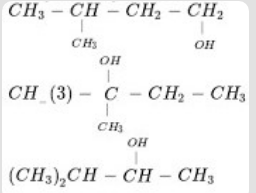
$(A)$ $\begin{matrix}
O\,\,\,\,\,\,\,\,\,\, \\
||\,\,\,\,\,\,\,\,\,\,\,\, \\
R-C-NHBr \\
\end{matrix}$ $(B)$ $R-NH-Br$
$(C)$ $R-N=C=O$ $(D)$ $\begin{matrix}
\,\,\,\,O\,\,\,\,\,\,\,\,\,\, \\
\,\,\,\,\,\,||\,\,\,\,\,\,\,\,\,\,\,\, \\
R-C-NB{{r}_{2}} \\
\end{matrix}$
(Given atomic number: $\mathrm{Sc}=21, \mathrm{Ti}=22, \mathrm{~V}=23$, $\mathrm{Cr}=24, \mathrm{Mn}=25$ and $\mathrm{Zn}=30)$
$Image$
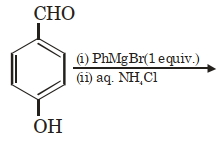
The number of hydroxyl groups present in the product $\mathrm{P}$ is______.