MCQ
In argon atom how many electrons have $m_{\ell } = 1$ ?
  • $4$
  • B
    $2$
  • C
    $1$
  • D
    $6$

Answer

Correct option: A.
$4$
a
Argon has $18$ electrons

$A r(18)=1 s^2 \,2 s^2 \,2 p^6 \,3 s^2\, 3 p^6$

Value of $m_l \in(-l, l)$

where $l$ is aximuthat quantum number.

Total number of electrons for $m_l=1$ are $4$

Need a full question paper?

Generate a complete, print-ready paper with questions like this in minutes — across 16+ boards, with answer keys.

Start Generating Free

Similar questions

The silicate anion in the mineral kinoite is a chain of three $SiO_4$ tetrahedra that share corners with adjacent tetrahedra. The mineral also contains $Ca^{2+}$ ions, $Cu^{2+}$ ions, and water molecules in a $1 : 1 : 1$ ratio mineral is represented as:
The equilibrium constant for the reversible reaction, ${N_2} + 3{H_2}$ $\rightleftharpoons$ $2N{H_3}$ is $K$ and for the reaction $\frac{1}{2}{N_2} + \frac{3}{2}{H_2}$ $\rightleftharpoons$ $N{H_3}$ the equilibrium constant is $K'$. $K$ and $K'$ will be related as
A solution containing $N{a_2}C{O_3}$ and $NaOH$ requires $300\, ml$ of $0.1\, N$ $HCl$ using phenolpthalein as an indicator. Methyl orange is then added to the above titrated solution when a further $25\, ml$ of $0.2\, N$ $HCl$ is required. The amount of $NaOH$ present in solution is  ................. $\mathrm{g}$  $(NaOH = 40,\,N{a_2}C{O_3} = 106)$
$C_2H_2$ is isostructural with
Combustion of $1$ mole of benzene is expressed at

$\mathrm{C}_6 \mathrm{H}_6(1)+\frac{15}{2} \mathrm{O}_2(\mathrm{~g}) \rightarrow \mathrm{CO}_2(\mathrm{~g})+3 \mathrm{H}_2 \mathrm{O}(1) \text {. }$

The standard enthalpy of combustion of $2 \mathrm{~mol}$ of benzene is - ' $x$ ' $k J$.

$\mathrm{x}=$. . . . . . . . . .

$(1)$ standard Enthalpy of formation of $1 \mathrm{~mol}$ of $\mathrm{C}_6 \mathrm{H}_6(1)$, for the reaction $6 \mathrm{C}$ (graphite) $+3 \mathrm{H}_2(\mathrm{~g}) \rightarrow \mathrm{C}_6 \mathrm{H}_n(1)$ is $48.5 \mathrm{~kJ} \mathrm{~mol}^{-1}$.

$(2)$ Standard Enthalpy of formation of $1 \mathrm{~mol}$ of $\mathrm{CO}_2(\mathrm{~g})$, for the reaction $\mathrm{C}$ (graphite) $+\mathrm{O}_{2(\mathrm{~g})} \rightarrow \mathrm{CO}_2(\mathrm{~g})$ is $-393.5 \mathrm{~kJ} \mathrm{~mol}^{-1}$.

$(3)$ Standard and Enthalpy of formation of $1 \mathrm{~mol}$ of $\mathrm{H}_2 \mathrm{O}(1)$, for the reaction $\mathrm{H}_2(\mathrm{~g})+\frac{1}{2} \mathrm{O}_2(\mathrm{~g}) \rightarrow \mathrm{H}_2 \mathrm{O}(1)$ is $-286 \mathrm{~kJ} \mathrm{~mol}^{-1}$.
At constant $T$ and $P$, which one of the following statements is correct for the reaction, $CO(g) + \frac{1}{2}{O_2}(g) \to C{O_2}(g)$
The frequency of yellow light having wavelength $600$ $nm$ is
Carbon and silicon belong to $(IV)$ group. The maximum coordination number of carbon in commonly occurring compounds is $4$, whereas that of silicon is $6$. This is due to
Concentration of $H^+$ ions in $10^{-4}\,M\,HCl$ solution is
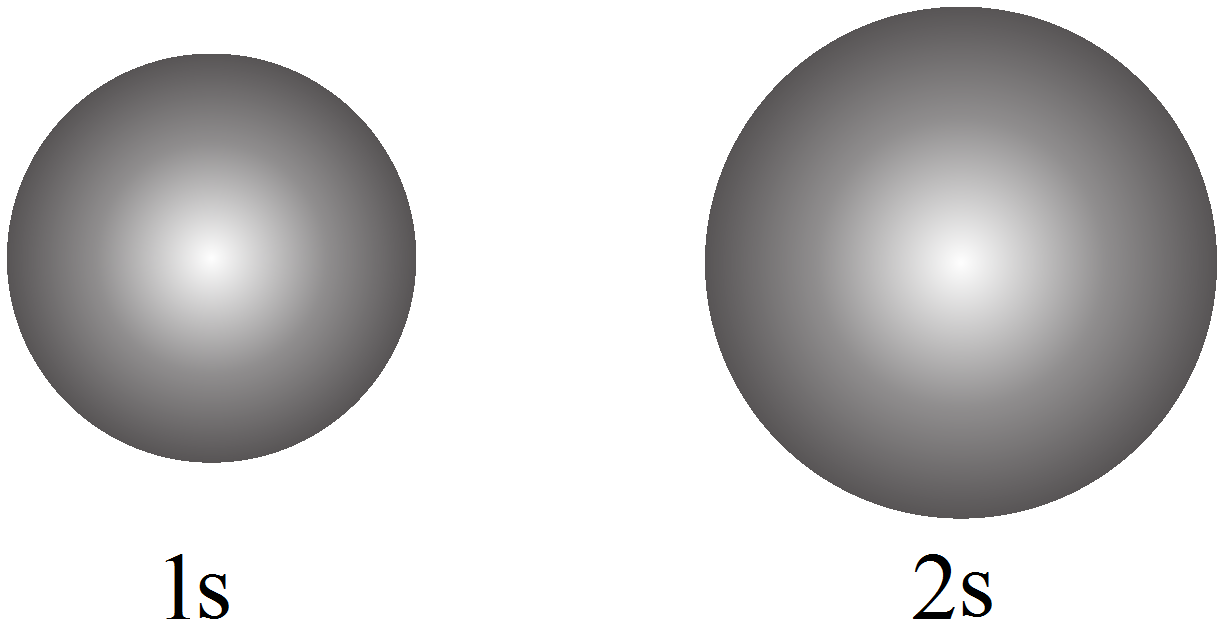
The probability density plots of $1s$ and $2s$ orbitals are given in figure.

The density of dots in a region represents the probability density of finding electrons in the region.
On the basis of above diagram which of the following statements is incorrect?