Question
In beta decay, an electron (or a positron) is emitted by a nucleus. Does the remaining atom get oppositely charged?

Answer

In beta decay, a neutron from the nucleus is converted to a proton releasing an electron and an antineutrino or a proton is converted to a neutron releasing a positron and a neutrino.
$\beta^-\text{decay:}\text{ n}\rightarrow\text{p + e + }\vec{\text{v}}$
$\beta^+\text{decay:}\text{ p}\rightarrow\text{n + e}^+ + \text{v}$
Since the number of valence electrons present in the parent atom do not change, the remaining atom does not get oppositely charged. Instead, due to a change in the atomic number, there's a formation of a new element.

Need a full question paper?

Generate a complete, print-ready paper with questions like this in minutes — across 16+ boards, with answer keys.

Start Generating Free

Similar questions

A hemispherical bowl of radius R is rotated about its axis of symmetry which is kept vertical. A small block is kept in the bowl at a position where the radius makes an angle $\theta$ with the vertical. The block rotates with the bowl without any slipping. The friction coefficient between the block and the bowl surface is $\mu.$ Find the range of the angular speed for which the block will not slip.
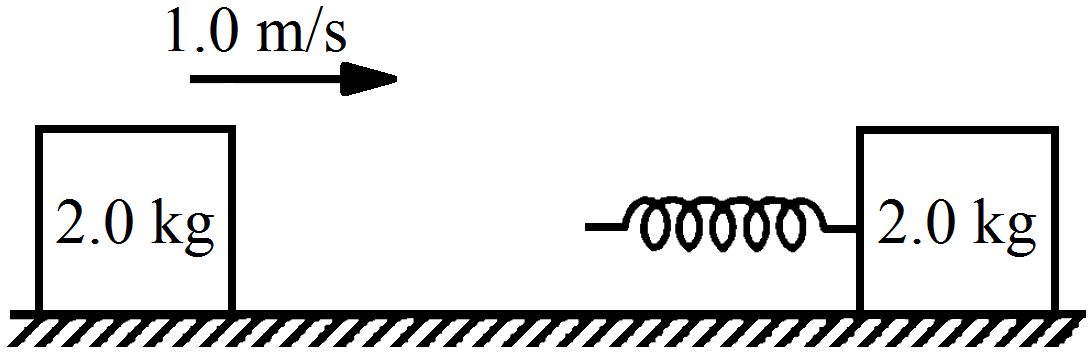
A block of mass 2.0kg is moving on a frictionless horizontal surface with a velocity of 1.0m/s towards another block of equal mass kept at rest. The spring constant of the spring fixed at one end is 100N/m. Find the maximum compression of the spring.

If light passes near a massive object, the gravitational interaction causes a bending of the ray. This can be thought of as happening due to a change in the effective refrative index of the medium given by
$\text{n}(\text{r})=1+2\frac{\text{GM}}{\text{rc}^2}$
where r is the distance of the point of consideration from the centre of the mass of the massive body, G is the universal gravitational constant, M the mass of the body and c the speed of light in vacuum. Considering a spherical object find the deviation of the ray from the original path as it grazes the object.
A hollow sphere is released from the top of an inclined plane of inclination $\theta.$
  1. What should be the minimum coefficient of friction between the sphere and the plane to prevent sliding?
  2. Find the kinetic energy of the ball as it moves down a length 1 on the incline if the friction coefficient is half the value calculated in part (a).
The capacitance between the adjacent plates shown in figure is 50nF. A charge of $1.0\mu\text{C}$ is placed on the middle plate:

  1. What will be the charge on the outer surface of the upper plate?
  2. Find the potential difference developed between the upper and the middle plates.
Write in detail the important results related to conductive electrostatics.
Define power and explain the following points (a) Instantaneous power (b) average power (c) power factor
  1. Draw a labelled ray diagram to obtain the real image formed by an astronomical telescope in normal adjustment position. Define its magnifying power.
  2. You are given three lenses of power 0.5 D, 4 D and 10 D to design a telescope:
  1. Which lenses should he used as objective and eyepiece? Justify your answer.
  2. Why is the aperture of the objective preferred to be large?
The coil of an electric bulb takes 40 watts to start glowing. If more than 40W is supplied, 60% of the extra power is converted into light and the remaining into heat. The bulb consumes 100W at 220V. Find the percentage drop in the light intensity at a point if the supply voltage changes from 220V to 200V.