Question
In Boyle's law what remains constant

Answer

Boyle's law states that at coustant temperature, the volume of a given mass of a dry gas is inversely proportional to its pressure.

i.e., $V \propto \frac{1}{P}$

$\therefore P V=$ constant

Correct choice - option- $A$

Need a full question paper?

Generate a complete, print-ready paper with questions like this in minutes — across 16+ boards, with answer keys.

Start Generating Free

Similar questions

$ABCDEF$ is a regular hexagon and forces represented in magnitude and direction by  $AB, AC,AD, AE$ and $AF$ act at $A$. Their resultant is :
Which of the following compounds does not contain an $ - OH$ group
A projectile is thrown from a point $O$ on the ground at an angle $45^{\circ}$ from the vertical and with a speed $5 \sqrt{2} m / s$. The projectile at the highest point of its trajectory splits into two equal parts. One part falls vertically down to the ground, $0.5 s$ after the splitting. The other part, $t$ seconds after the splitting, falls to the ground at a distance $x$ meters from the point $O$. The acceleration due to gravity $g =10 m / s ^2$.

($1$) The value of $t$ is. . . . . . 

($2$) The value of $x$ is. . . . . 

Give the answer or qution ($1$) and ($2$)

The diagrams below show the intensity distribution in diffraction of light of two sources. In which of the following cases the sources are just resolved?
The induction coil works on the principle of
The photoelectric threshold for a certain metal surface is $330 \,\mathring A$. What is the maximum kinetic energy of the photoelectrons emitted, if radiations of wavelength $1100 \,\mathring A$ are used ?
Suppose there is a hole in a copper plate. On heating the plate, diameter of hole, would
The magnitude of pairs of displacement vectors are given. Which pair of displacement  vectors cannot be added to give a resultant vector of magnitude $13\, cm$?
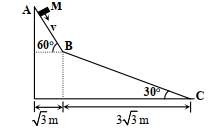
A small block of mass $M$ moves on a frictionless surface of an inclined plane, as shown in figure. The angle of the incline suddenly changes from $60^{\circ}$ to $30^{\circ}$ at point $\mathrm{B}$. The block is initially at rest at $A$. Assume that collisions between the block and the incline are totally inelastic $\left(\mathrm{g}=10 \mathrm{~m} / \mathrm{s}^2\right)$.

Figure: $Image$

$1.$ The speed of the block at point $B$ immediately after it strikes the second incline is

$(A)$ $\sqrt{60} \mathrm{~m} / \mathrm{s}$ $(B)$ $\sqrt{45} \mathrm{~m} / \mathrm{s}$

$(C)$ $\sqrt{30} \mathrm{~m} / \mathrm{s}$ $(D)$ $\sqrt{15} \mathrm{~m} / \mathrm{s}$

$2.$ The speed of the block at point $\mathrm{C}$, immediately before it leaves the second incline is

$(A)$ $\sqrt{120} \mathrm{~m} / \mathrm{s}$ $(B)$ $\sqrt{105} \mathrm{~m} / \mathrm{s}$

$(C)$ $\sqrt{90} \mathrm{~m} / \mathrm{s}$ $(D)$ $\sqrt{75} \mathrm{~m} / \mathrm{s}$

$3.$ If collision between the block and the incline is completely elastic, then the vertical (upward) component of the velocity of the block at point $B$, immediately after it strikes the second incline is

$(A)$ $\sqrt{30} \mathrm{~m} / \mathrm{s}$ $(B)$ $\sqrt{15} \mathrm{~m} / \mathrm{s}$

$(C)$ 0 $(D)$ $-\sqrt{15} \mathrm{~m} / \mathrm{s}$

Give the answer question $1,2$ and $3.$
A body is moving unidirectionally under the influence of a constant power source. Its displacement in time $t$ is proportional to :