MCQ
In Boyle's law what remains constant
  • $PV$
  • B
    $TV$
  • C
    $\frac{V}{T}$
  • D
    $\frac{P}{T}$

Answer

Correct option: A.
$PV$
a
Boyle's law states that at coustant temperature, the volume of a given mass of a dry gas is inversely proportional to its pressure.

i.e., $V \propto \frac{1}{P}$

$\therefore P V=$ constant

Correct choice - option- $A$

Need a full question paper?

Generate a complete, print-ready paper with questions like this in minutes — across 16+ boards, with answer keys.
Start Generating Free

Similar questions

A liquid of density $\rho $ is coming out of a hose pipe of radius $a$ with horizontal speed $v$ and hits a mesh. $50\%$ of the liquid passes through the mesh unaffected. $25\%$ looses all of its momentum and $25\%$ comes back with the same speed. The resultant pressure on the mesh will be
At what point of a projectile motion acceleration and velocity are perpendicular to each other
$5\,\,gm.$  of ice at $0\,^oC$  is dropped in a beaker containing $20\,\,gm.$ of water at $40\,^oC.$ The final temperature will be  ........ $^oC$
The amount of work done in forming a soap film of size $10\,cm \times 10\,cm$ is (Surface tension $T = 3 \times {10^{ - 2}}\,N/m$)
$Assertion$ : A tennis ball bounces higher on hills than in plains.
$Reason$ : Acceleration due to gravity on the hill is greater than that on the surface of earth
Two springs of spring constants $1500\, N/m$ and $3000\, N/m$ respectively are stretched with the same force. They will have potential energy in the ratio
Time period of a simple pendulum will be double, if we
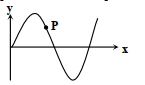
A transverse sinusoidal wave moves along a string in the positive $\mathrm{x}$-direction at a speed of $10 \mathrm{~cm} / \mathrm{s}$. The wavelength of the wave is $0.5 \mathrm{~m}$ and its amplitude is $10 \mathrm{~cm}$. At a particular time $t$, the snap -shot of the wave is shown in figure. The velocity of point $P$ when its displacement is $5 \mathrm{~cm}$ is Figure: $Image$
Two billiard balls A and B, each of mass 50g and moving in opposite directions with speed of 5m s–1 each, collide and rebound with the same speed. If the collision lasts for 10–3s, which of the following statements are true?
Temperature can be expressed as a derived quantity in terms of any of the following