Question
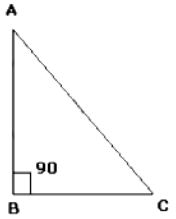
In $\triangle ABC, \angle B = 90^\circ .$ If $AB = 12$ units and $BC = 5$units, find: $\cot C$

Answer

Image
In $\triangle ABC,$
$AC^2 = AB^2 + BC^2$
$\Rightarrow AC =\sqrt{ AB ^2+ BC ^2}$
$\Rightarrow AC =\sqrt{12^2+5^2}$
$=\sqrt{144+25}$
$= 13$
$AB = 12$ units
$BC = 5$ units
$AC = 13$ units
$\cot C$
$=\frac{\text { Base }}{\text { Perpendicular }}$
$=\frac{ BC }{ AB }$
$=\frac{5}{12} .$

Need a full question paper?

Generate a complete, print-ready paper with questions like this in minutes — across 16+ boards, with answer keys.
Start Generating Free

Similar questions

An isosceles $\triangle ABC$ has $AC = BC. CD$ bisects $AB$ at $D$ and $\angle CAB = 55^o$.Find:$(i)\angle DCB(ii)\angle CBD.$
The weekly wages (in rupees) of 30 workers in a factory are given below :
630, 635, 690, 610, 635, 636, 639, 645, 698, 690, 620, 660, 632, 633, 655, 645, 604, 608, 612, 640, 685, 635, 636, 678, 640, 668, 690, 606, 640, 690
Represent the data in the form of a frequency distribution with class size 10.
If $a + b + c = 0$; then show that $a^3 + b^3 + c^3 = 3abc$.
If $x^2+y^2=7 x y$, prove that $\log \left(\frac{x-y}{3}\right)=\frac{1}{2}(\log x+\log y)$
For the pair of linear equations given below, draw graphs and then state, whether the lines drawn are parallel or perpendicular to each other$.y = x - 3,y = - x + 5$
The sum of the numerator and the denominator of a fraction is equal to $7.$ Four times the numerator is $8$ less than $5$ times the denominator. Find the fraction.
Prove that if the diagonals of a parallelogram are equal then it is a rectangle.
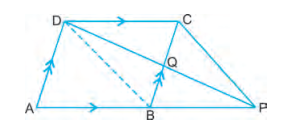
In the adjoining figure, ABCD is a parallelogram. AB is produced to a point P and DP intersects $B C$ at $Q$.
Prove that : $\operatorname{ar}(\triangle APD )=\operatorname{ar}($ quad. BPCD $)$.
Image
At what rate percent will $Rs.12000$ yield $Rs.13891.50$ as compound interest in $3$ years?
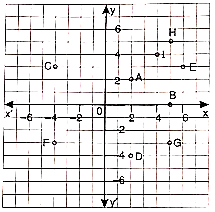
Use the graph given alongside, to find the coordinates of the point $(s)$ satisfying the given condition:$(i)$ The abscissa is $2.(ii)$The ordinate is $0.(iii)$ The ordinate is $3.(iv)$ The ordinate is $-4.(v)$ The abscissa is $5.(vi)$ The abscissa is equal to the ordinate.$(vii)$ The ordinate is half of the abscissa.