MCQ
In electrolysis of dilute ${H_2}S{O_4}$using platinum electrodes
  • ${H_2}$ is evolved at cathode
  • B
    $N{H_3}$ is produced at anode
  • C
    $C{l_2}$ is obtained at cathode
  • D
    ${O_2}$ is produced

Answer

Correct option: A.
${H_2}$ is evolved at cathode
a
(a)When platinum electrodes are dipped in dilute solution ${H_2}S{O_4}$ than ${H_2}$ is evolved at cathode.

Need a full question paper?

Generate a complete, print-ready paper with questions like this in minutes — across 16+ boards, with answer keys.
Start Generating Free

Similar questions

If $EAN$ of central metal cation $M^{2+}$ in a non-chelating complex is $36$ and  atomic no. of metal $M$ is $26$, then the number of monodentate ligand in this  complex are 
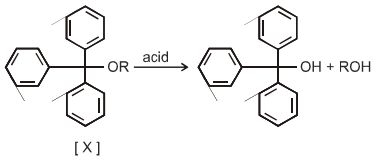
The acidic hydrolysis of ether $( X )$ shown below is fastest when :
Which of the following acid is normally handled in metal apparatus made of $Cu$ because it attacks on glass
The rate law for the reaction$RCl + NaOH(aq) \to ROH + NaCl$ is given by Rate $ = {K_1}[RCl]$. The rate of the reaction will be
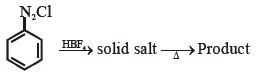
The main product of following reaction will be
$12\, g$ of a nonvolatile solute dissolved in $108\, g$ of water produces the relative lowering of vapour pressure of $0.1$. The molecular mass of the solute is 
A $1.0\,M$ with respect to each of the metal halides $AX_3 ,\,BX_2 ,\,CX_3$ and $DX_2$ is electrolysed using platinum electrodes. If

$E_{{A^{3 + }}/A}^o = 1.50\,\,V\,,$    $E_{{B^{2 + }}/B}^o = 0.3\,\,V,$

$E_{{C^{3 + }}/C}^o =  - \,0.74\,\,V,$  $E_{{D^{2 + }}/D}^o =  - \,2.37\,\,V.$

The correct sequence in which the various metals are deposited at the cathode is

Type of isomerism exhibited by $\left[\mathrm{Cr}(\mathrm{NCS})\left(\mathrm{NH}_3\right)_5\right]\left[\mathrm{ZnCl}_4\right]$ is:
On adding few drops of dilute $\text{HCl}$ or $\text{FeCl}_3$ to freshly precipitated ferric hydroxide, a red coloured colloidal solution is obtained. This phenomenon is known as:
Of the following, which is the product formed when cyclohexanone undergoes aldol condensation followed by heating ?