MCQ
In ethers, the  $C -O -C$  bond angle is ........ $^o$
  • A
    ${180}$
  • B
    ${90}$
  • ${110}$
  • D
    ${160}$

Answer

Correct option: C.
${110}$
c
Oxygen atom in ether is $sp ^3$ hybridised, therefore has tetrahedral geometry where two positions are occupied by lone pair of electrons and the other two by the alkyl groups in ether. The bond angle in regular tetrahedral is $109^{\circ} 28^{\prime}$. In general, the lone pairs on $O$ tend to repel the bond pairs and results in lower bond angles than $109^{\circ}$ but in ethers the $C - O - C$ bond angle is slightly more than this i.e nearly $110^{\circ}$. This is because of the presence of bulky alkyl group on $O$ atom that repel each other and counterbalance the repulsion due to lone pair on $O$ atom on bond pairs and results in bond angle slightly greater than tetrahedral angle.Thus, C-O-C bond angle in ether is about $110^{\circ}$.

Need a full question paper?

Generate a complete, print-ready paper with questions like this in minutes — across 16+ boards, with answer keys.

Start Generating Free

Similar questions

Vapour pressure of chloroform $(CHCl_3)$ and dichloromethane $(CH_2Cl_2)$ at $25^o C$ are $200\, mm\, Hg$ and $41.5\, mm \,Hg$ respectively. Vapour pressure of the solution obtained by mixing $25.5\, g$ of $CHCl_3$ and $40 \,g$ of $CH_2Cl_2$ at the same temperature will be

(Molecular mass of $CHCl_3 = 119.5 \,u$ and molecular mass of $CH_2Cl_2 = 85\, u$)

The elements with atomic numbers $101$ and $104$ belong to, respectively
Addition of which chemical will decrease the hydrogen ion concentration of an acetic acid solution
$20\,mL$ of $0.1\,M\,NH _{4} OH$ is mixed with $40\,mL$ of $0.05\,M\,HCl$. The $pH$ of the mixture is nearest to.(Given: $K _{ b }\left( NH _{4} OH \right)=1 \times 10^{-5}, \log 2=0.30$,$\log 3=0.48, \log 5=0.69, \log 7=0.84$,$\log 11=1.04)$
Which orbital is dumb-bell shaped ?
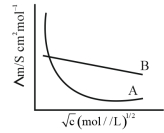
Following figure shows dependence of molar conductance of two electrolytes on concentration. $\Lambda \stackrel{0}{ m }$ is the limiting molar conductivity.The number of Incorrect statement(s) from the following is $...........$

$(A)$ $\Lambda \stackrel{0}{ m }$ for electrolyte $A$ is obtained by extrapolation

$(B)$ For electrolyte B, vx $\Lambda m$ vs $\sqrt{ c }$ graph is a straight line with intercept equal to $\Lambda \stackrel{0}{ m }$

$(C)$ At infinite dilution, the value of degree of dissociation approach zero for electrolyte $B$.

$(D)$ $\Lambda \stackrel{0}{ m }$ for any electrolyte $A$ or $B$ can be calculated using $\lambda^{\circ}$ for individual ions.
Which bond angle $\theta $ gives maximum dipole moment for triatomic molecule $XY_2$
The element used by Rutherford in his famous scattering experiment was
The electrophile involved in Reimer-Tiemann reaction is
Benzene on treatment with a mixture of conc. $HN{O_3}$ and conc. ${H_2}S{O_4}$ at ${100\,^o}C$ gives