Question
In eukaryotes, explain splicing & tailing (figure is not necessary).

Answer

→ In eukaryotes, there are two additional complexities
(i) There are at least three RNA polymerases in the nucleus (in addition to the RNA polymerase found in the organelles). There is a clear cut division of labour. The RNA polymerase I transcribes rRNAs (28S, 18S, and 5.8S), whereas the RNA polymerase III is responsible for transcription of tRNA, 5srRNA, and snRNAs (small nuclear RNAs). The RNApolymerase II transcribes precursor of mRNA, the heterogeneous nuclear RNA (hnRNA).
(ii) The second complexity is that the primary transcripts contain both the exons and the introns and are non-functional.
→ Post-Transcriptional changes
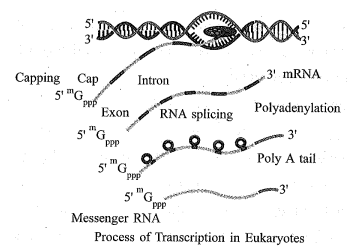
→ Hence, it is subjected to a process called splicing where the introns are removed and exons are joined in a defined order.
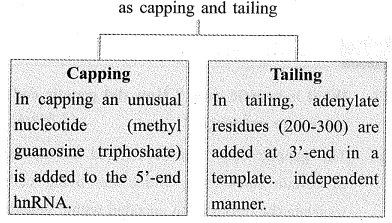
hnRNA undergoes additional processing called
Image
→ It is the fully processed hnRNA, now called mRNA, that is transported out of the nucleus for translation.
→ The significance of such complexities is now beginning to be understood. The split-gene arrangements represent probably an ancient feature of the genome.
→ The presence of introns is reminiscent of antiquity, and the process of splicing represents the dominance of RNA-world.
→ In recent times, the understanding of RNA and RNA-dependent processes in the living system have assumed more importance.
Image

Need a full question paper?

Generate a complete, print-ready paper with questions like this in minutes — across 16+ boards, with answer keys.

Start Generating Free

Similar questions

Briefly describe the following: Bioinformatics
Explain in detail about pollen-pistil interaction.
When Morgan conducted a dihybrid cross on Drosophila like Mendel did with pea plants, the F, ratios deviated significantly from that of Mendels F, ratio. Write the explanation Morgan and his group gave for the observations they obtained from their experiments.

Or

Morgan carried out several dihybrid crosses in Drosophila and found F, ratios deviated very significantly from the expected Mendelian ratio. Explain his findings with the help of an example.

On world population day, Rohit and his friends arranged an awareness campaign on population explosion programme in their locality. Some elderly people tried to stop the children and asked them not to talk on such things in public. The children convinced the elders about the need for the programme and on understanding their point of view, the elders also joined the campaign.
  1. Why is such awareness programme necessary?
  2. What role has the government played in controlling population explosion?
  3. When were reproductive health programmes initiated in India?
  4. What values did Rohit and his friends show on the occasion?
Compare polymerase chain reaction and gene cloning.
Two children, A and B aged 4 and 5 years respectively visited a hospital with a similar genetic disorder. The girl A was provided enzyme-replacement therapy and was advised to revisit periodically for further treatment. The girl, B was, however, given a therapy that did not require revisit for further treatment.
  1. Name the ailments the two girls were suffering from?
  2. Why did the treatment provided to girl A required repeated visits?
  3. How was the girl B cured permanently?
Explain the various steps involved in the production of artificial insulin.
Mark the odd one the following groups.
Luteinizing hormone, Progesterone, Chorionic gonadotropin, Estrogen.
Fertilisation is essential for production of seed, but in some angiosperms, seeds develop without fertilisation.
Explain the two ways by which seeds develop without fertilisation.
Give three hypotheses for explaining why tropics show greatest levels of species richness.