Question
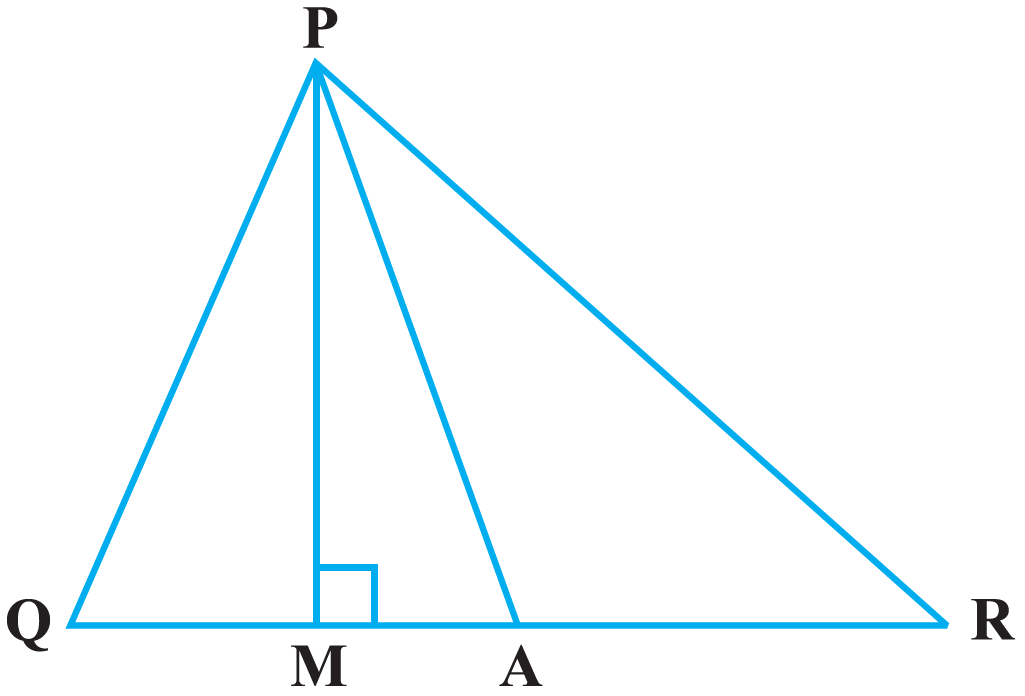
In Fig. $\angle\text{Q}>\angle\text{R}, PA$ is the bisector of $\angle\text{QPR}$ and $\text{PM}\perp\text{QR}$ Prove that $\angle\text{APM}=\frac{1}{2}(\angle\text{Q}-\angle\text{R}).$
Answer

Given In $\Delta\text{PQR},\angle\text{Q}>\angle\text{R},$PA is the bisector of $\angle\text{QPR}$ and $\text{PM}\perp\text{QR}.$ To prove $\angle\text{APM}=\frac{1}{2}(\angle\text{Q}-\angle\text{R})$ Proof Since, $PA$ is the bisector of $\angle\text{QPR}.$
$\therefore\ \angle\text{QPA}=\angle\text{APR}$ In $\Delta\text{PQM},$
$\angle\text{PQM}+\angle\text{PMQ}+\angle\text{QPM}=180^\circ...(\text{i}) [$by angle sum property of a triangle$]$ $\Rightarrow\angle\text{PQM}+90^\circ+\angle\text{QPM}=180^\circ$
$\big[\because\ \text{PM}\perp\text{QR}\Rightarrow\angle\text{PMQ}=90^\circ\big]$
$\Rightarrow\angle\text{PQM}=90^\circ-\angle\text{QPM}...(\text{ii})$ In $\Delta\text{PMR},$
$\angle\text{PMR}+\angle\text{PRM}+\angle\text{RPM}=180^\circ [$by angle sum property of a triangle$]$
$\Rightarrow90^\circ+\angle\text{PRM}+\angle\text{RPM}=180^\circ$
$\big[\because\ \text{PM}\perp\text{QR}\Rightarrow\angle\text{PMR}=90^\circ\big]$
$\Rightarrow\angle\text{PRM}=180^\circ-90^\circ-\angle\text{RPM}$
$\Rightarrow\angle\text{PRM}=90^\circ-\angle\text{RPM}..(\text{iii})$ On subtracting Eq. $(iii)$ from Eq. $(ii),$
we get $\angle\text{Q}-\angle\text{R}=(90^\circ-\angle\text{QPM})-(90^\circ-\angle\text{RPM})$
$\big[$ where $\angle\text{PQM}=\angle\text{Q}$ and $\angle\text{PRM}=\angle\text{R}\big]$
$\Rightarrow\angle\text{Q}-\angle\text{R}=\angle\text{RPM}-\angle\text{QPM}$
$\Rightarrow\angle\text{Q}-\angle\text{R}=\big[\angle\text{RPA}+\angle\text{APM}\big]-\big[\angle\text{QPA}-\angle\text{APM}\big]..(\text{iv})$
$\Rightarrow\angle\text{Q}-\angle\text{R}=\angle\text{QPAS}+\angle\text{APM}-\angle\text{QPA}+\angle\text{APM} [$by using Eq. $(i)]$
$\Rightarrow\angle\text{Q}-\angle\text{R}=2\angle\text{APM}$
$\therefore\angle\text{APM}=\frac{1}{2}(\angle\text{Q}-\angle\text{R})$

Need a full question paper?

Generate a complete, print-ready paper with questions like this in minutes — across 16+ boards, with answer keys.
Start Generating Free

Similar questions

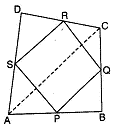
$A B C D$ is a quadrilateral in which $P, Q, R$ and $S$ are mid-points of the sides $A B, B C, C D$ and $D A . A C$ is a diagonal. Show that
i. $S R \| A C$ and $S R=\frac{1}{2} A C$
ii. $P Q=S R$
iii. $PQRS$ is a parallelogram.
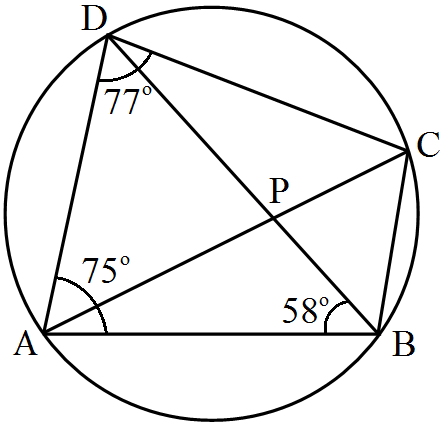
In the given figure, $ABCD$ is a cyclic quadrilateral in which $\angle\text{BAD} = 75^\circ,\ \angle\text{ABD} = 58^\circ$ and $\angle\text{ADC} = 77^\circ, AC$ and $BD$ intersect at $P.$ Then, find $\angle\text{DPC}.$
If $\text{x}+\frac{1}{\text{x}}=3,$ calculate $\text{x}^2+\frac{1}{\text{x}^2},\ \text{x}^3+\frac{1}{\text{x}^3}$ and $\text{x}^4+\frac{1}{\text{x}^4}.$
The radius of the base and the height of a cylinder are in the ratio $2 : 3$. If its volume is $1617cm^3$, find the total surface area of the cylinder.
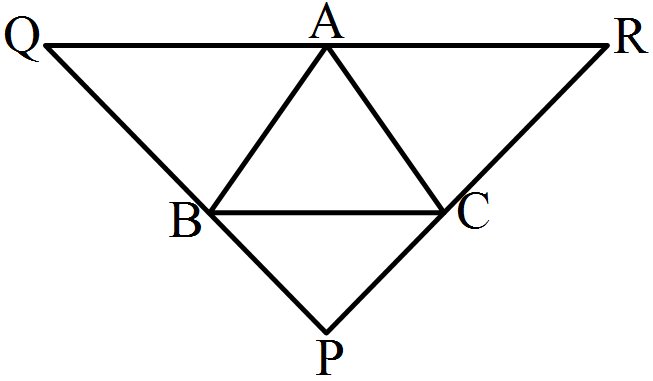
A $\triangle\text{ABC}$ is given. If lines are drawn through $A, B, C,$ parallel respectively to the sides $BC, CA$ and $AB$, forming $\triangle\text{PQR},$ as shown in the adjoining figure, show that $\text{BC}=\frac{1}{2}\text{QR}.$
The mean of $20$ numbers is $18$. If $3$ is added to each of the first ten numbers, find the mean of the new set of $20$ numbers.
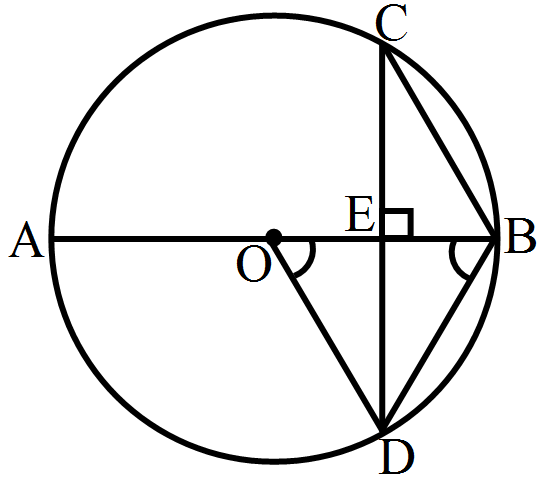
In the given figure, $O$ is the centre of the circle, $BD = OD$ and $\text{CD}\perp\text{AB}.$ Find $\angle\text{CAB}.$
The total surface area of a solid cylinder is $231cm^2$ and its curved surface area is $\frac{2}{3}$ of the total surface area. Find the volume of the cylinder.
The factors of $8a^3 + b^3 - 6ab + 1$ are:
Show the diagonals of a square are equal and bisect each other at right angles.