Question
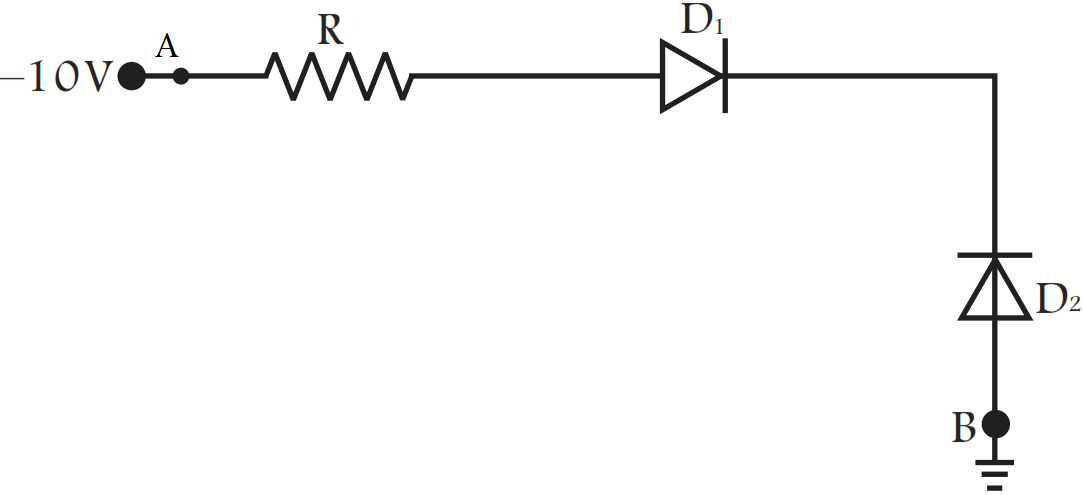
In Fig., assuming the diodes to be ideal:

Answer

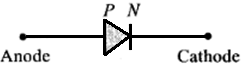
A symbol of the diode is represented like this : In this problem first we have to check the polarity of the diodes. $-10$ is the lower voltage in the circuit.
Now $p-$side of $p-n$ juction $D_1$ is connected to lower voltage and $n-$side of $D_1$ to higher voltage.
Thus $D_1$ is reverse biased.
Now, let us analyse $2^{nd}$ diode of the given circuit.
The $p-$side of $p-n$ junction $D_1$ is at higher potential and $n-$side of $D_2$ is at lower potential.
Therefore $D_2$ is forward biased.

Hence, current flows through the jucntion from $B$ to $A$.

Need a full question paper?

Generate a complete, print-ready paper with questions like this in minutes — across 16+ boards, with answer keys.
Start Generating Free

Similar questions

If the light moving in a straight line bends by a small but fixed angle, it may be a case of:
  1. Reflection.
  2. Refraction.
  3. Diffraction.
  4. Dispersion.
In Young's double$-$slit experiment, an interference pattern is obtained on a screen by a light of wavelength $6000 \mathring A$, coming from the coherent sources $S_1$ and $S_2$. At certain point $P$ on the screen third dark fringe is formed. Then the path difference $S_1 P-S_2 P$ in microns is
The oscillating electric and magnetic vectors of an electromagnetic wave are oriented along
An electric bulb marked 40 W and 200 V, is used in a circuit of supply voltage 100 V. Now its power is(a) 100W(b) 40W(c) 20W   (d) 10W
       
Which of the following is the best insulator?
The magnetic moment of a current carrying loop is $2.1 \times 10^{-25} \ce{amp \times m ^2}$. The magnetic field at a point on its axis at a distance of $1 \mathring A$  is
In the Bohr model of a hydrogen atom, the centripetal force is furnished by the coulomb attraction between the proton and the electron. If $\mathrm{a}_0$ is the radius of the ground state orbit, $m$ is the mass, $e$ is the charge on the electron and $\varepsilon_0$ is the vacuum permittivity, the speed of the electron is
A uniform magnetic field acts at right angles to the direction of motion of electrons. As a result, the electron moves in a circular path of  radius 2 cm. If the speed of the electrons is doubled, then the radius of the circular path will be(a) 2.0 cm(b) 0.5 cm(c) 4.0 cm(d) 1.0 cm
       
The breaking stress of a wire depends on:
  1. Material of the wire.
  2. Length of the wire.
  3. Radius of the wire.
  4. Shape of the cross-section.
In forward bias, the width of potential barrier in a P-N junction diode(a) Increases(b) Decreases(c) Remains constant(d) First increases then decreases