Question
In Figure ABCD is a regular hexagon, which vectors are:
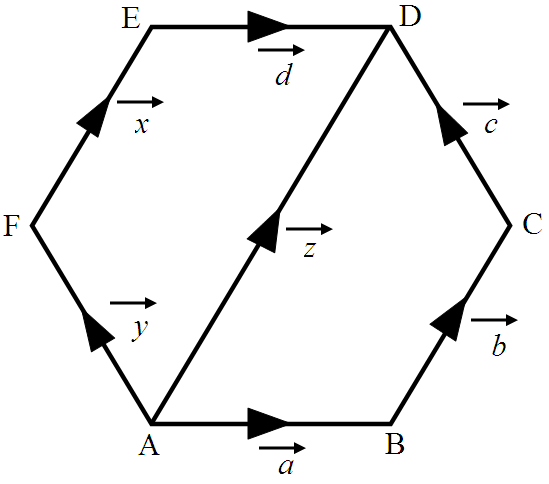
  1. Collinear.
  2. Equal.
  3. Co-initial.
  4. Collinear but not equal.

Answer

  1. Vectors having the same or parallel supports are called collinear vector. In the given figure the collinear vectors are,
$\vec{\text{a}},\ \vec{\text{d}};\ \vec{\text{x}},\ \vec{\text{z}},\ \vec{\text{b}};\ \vec{\text{c}},\ \vec{\text{y}}$
  1. vectors having the same magnitude and direction are called equal vector. In the given figure the equal vectors are,
$\vec{\text{b}},\ \vec{\text{x}};\ \vec{\text{c}},\ \vec{\text{y}};\ \vec{\text{a}},\ \vec{\text{d}}$
  1. Vectors having the same initial point are called co-initial vector. In the given figure the co-initial vectors are,
$\vec{\text{a}},\ \vec{\text{y}},\ \vec{\text{z}}$
  1. The vectors which are collinear but not equal are $\vec{\text{b}},\ \vec{\text{z}};\ \vec{\text{x}},\ \vec{\text{z}}$

Need a full question paper?

Generate a complete, print-ready paper with questions like this in minutes — across 16+ boards, with answer keys.

Start Generating Free

Similar questions

Find the area under the curve $\text{y}=\sqrt{6\text{x}+4}$ above $x-$axis from $x = 0$ to $x = 2.$ Draw a sketch of curve also.
Evaluate the following integrals:
$\int\frac{(\text{x}\tan^{-1}\text{x})}{(1+\text{x}^2)^{\frac{3}{2}}}\text{dx}$
Let A = {1, 2, 3} and consider the relation R = {(1, 1), (2, 2), (3, 3), (1, 2), (2, 3), (1, 3)}. Then, R is:
  1. Reflexive but not symmetric.
  2. Reflexive but not transitive.
  3. Symmetric and transitive.
  4. Neither symmetric nor transitive.
A factory makes tennis rackets and cricket bats.A tennis racket takes 1.5 hours of machine time and 3 hours of craftman's time in its making while a cricket bat takes 3 hours of machine time and 1 hour of craftman's time. In a day, the factory has the availability of not more than 42 hours of machine time and 24 hours of craftsman's time. If the profit on a racket and on a bat is Rs. 20 and Rs. 10 respectively, find the number of tennis rackets and crickets bats that the factory must manufacture to earn the maximum profit.Make it as an L.P.P. and solve graphically.
Evaluate $\int\limits_1^3(\text{2x}^{2}+\text{5x})$ dx as a limit of a sum. 
Prove that: $\begin{vmatrix}\text{a}^2&\text{a}^2-(\text{b}-\text{c})^2&\text{bc}\\\text{b}^2&\text{b}^2-(\text{c}-\text{a})^2&\text{ca}\\\text{c}^2&\text{c}^2-(\text{a}-\text{b})^2&\text{ab}\end{vmatrix}$
$=(\text{a}-\text{b})(\text{b}-\text{c})(\text{c}-\text{b})(\text{a}+\text{b}+\text{c})(\text{a}^2+\text{b}^2+\text{c}^2)$
A firm manufactures two products, each of which must be processed through two departments, 1 and 2. The hourly requirements per unit for each product in each department, the weekly capacities in each department, selling price per unit, labour cost per unit, and raw material cost per unit are summarized as follows:
 
 
Product A
Product B
Weekly capacity
Department 1
3
2
130
Department 2
4
6
260
Selling price per unit
Rs. 25
Rs. 30
 
Labour cost per unit
Rs. 16
Rs. 20
 
Raw material cost per unit
Rs. 4
Rs. 4
 
The problem is to determine the number of units to produce each product so as to maximize total contribution to profit. Formulate this as a LPP.
There are two bags, one of which contains $3$ black and $4$ white balls while the other contains $4$ black and $3$ white balls. $A$ die is thrown. If it shows up $1$ or $3,$ a ball is taken from the Ist bag; but it shows up any other number, a ball is chosen from the second bag. Find the probability of choosing a black ball.
The slope of a curve at each of its points is equal to the square of the abscissa of the point. Find the particular curve through the point $(−1, 1)$.
If $\text{P}\big(\text{x}\big)=\begin{bmatrix}\cos\text{x}&\sin\text{x}\\-\sin\text{x}&\cos\text{x}\end{bmatrix},$ then show that P(x)P(y) = P(x + y) = P(y)P(x).