Question
In Figure ABCD is a regular hexagon, which vectors are:
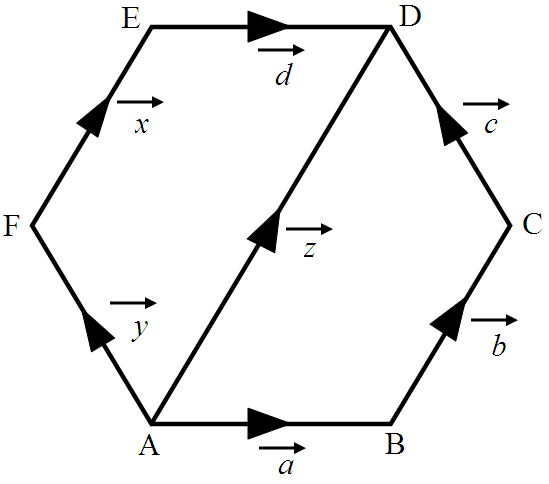
  1. Collinear.
  2. Equal.
  3. Co-initial.
  4. Collinear but not equal.

Answer

  1. Vectors having the same or parallel supports are called collinear vector. In the given figure the collinear vectors are,

$\vec{\text{a}},\ \vec{\text{d}};\ \vec{\text{x}},\ \vec{\text{z}},\ \vec{\text{b}};\ \vec{\text{c}},\ \vec{\text{y}}$

  1. vectors having the same magnitude and direction are called equal vector. In the given figure the equal vectors are,

$\vec{\text{b}},\ \vec{\text{x}};\ \vec{\text{c}},\ \vec{\text{y}};\ \vec{\text{a}},\ \vec{\text{d}}$

  1. Vectors having the same initial point are called co-initial vector. In the given figure the co-initial vectors are,

$\vec{\text{a}},\ \vec{\text{y}},\ \vec{\text{z}}$

  1. The vectors which are collinear but not equal are $\vec{\text{b}},\ \vec{\text{z}};\ \vec{\text{x}},\ \vec{\text{z}}$

Need a full question paper?

Generate a complete, print-ready paper with questions like this in minutes — across 16+ boards, with answer keys.

Start Generating Free

Similar questions

Prove that the area the first quadeant enclosed by the x-axis, the line $\text{x}=\sqrt{3}\text{y}$ and the circle is $\frac{\pi}{3}$ .
Find the relationship between 'a' and 'b' so that the function 'f' defind by $\text{f(x)}=\begin{cases}\text{ax}+1,&\text{if }\text{ x}\leq3\\\text{bx}+3,&\text{if }\text{ x}>3\end{cases}$ is continuous at x = 3.
In a binomial distribution the sum and product of the mean and the variance are $\frac{25}{3}$ and $\frac{50}{3}$ respectively. Find the distribution.
In a game, a man wins Rs 5 for getting a number greater than 4 and loses Rs 1 otherwise, when a fair die is thrown. The man decided to thrown a die thrice but to quit as and when he gets a number greater then 4. Find the expected value of the amount he wins or loses.
Verify Rolle's theorem for the following function on the indicated intervals

f(x) = x2 + 5 x + 6 on the interval [-3, -2]

Find the shortest distance between the lines $\frac{\text{x}+1}{7}=\frac{\text{y}+1}{-6}=\frac{\text{z}+1}{0}$ and $\frac{\text{x}-3}{1}=\frac{\text{y}-5}{-2}=\frac{\text{z}-7}{1}.$
Differentiate the following functions with respect to x:
$\log\sqrt{\frac{\text{x}-1}{\text{x}+1}}$
Solve the following system of equations by matrix method:
x + y + z = 6
x + 2z = 7
3x + y + z = 12
Give examples of two surjective functions f1 and f2 from Z to Z such that f1 + f2 is not surjective.
ABCD are four points in a plane and Q is the point of intersection of the lines joining the mid-points of AB and CD, BC and AD. Show that $\overrightarrow{\text{PA}}+\overrightarrow{\text{PB}}+\overrightarrow{\text{PC}}+\overrightarrow{\text{PD}}=4\ \overrightarrow{\text{PQ}}$, where P ia any point.