Question
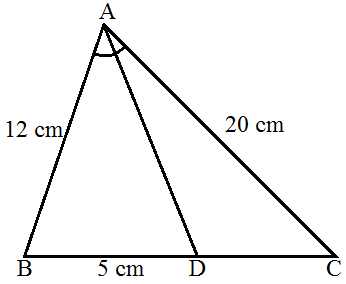
In figure, $AD$ bisects $\angle\text{A}, AB = 12\ cm, AC = 20\ cm, $ and $BD = 5\ cm.$ Determine $CD.$
Answer

In the $\triangle\text{ABC},$
$AD$ is the bisector of $\angle\text{A}$
$\therefore\frac{\text{AB}}{\text{AC}}=\frac{\text{BD}}{\text{CD}}$
$\Rightarrow\frac{12}{20}=\frac{5}{\text{CD}}\Rightarrow\text{CD}=\frac{20\times5}{12}$
$\Rightarrow\text{CD}=\frac{25}{3}=8.33$
$\therefore\text{CD}=8.33$

Need a full question paper?

Generate a complete, print-ready paper with questions like this in minutes — across 16+ boards, with answer keys.

Start Generating Free

Similar questions

What is the area of the triangle formed by the points $O(0, 0), A(6, 0)$ and $B(0, 4)?$
Evaluate:
$=\tan35^\circ \tan40 \tan50^\circ \tan55^\circ$
Solve the following quadratic equation:
$\sqrt3\text{x}^2+\text{11x}+6\sqrt3=0$
The marks distribution of $30$ students in a mathematics examination. Find the mode of this data. Also, compare and interpret the mode and the mean.
Class interval Number of students $(f_i)$ Classmark $( x_i)$ $f_ix_i$
$10 - 25$ $2$ $17.5$ $35.0$
$25 - 40$ $3$ $32.5$ $97.5$
$40 - 55$ $7$ $47.5$ $332.5$
$55 - 70$ $6$ $62.5$ $375.0$
$70 - 85$ $6$ $77.5$ $465.0$
$85 - 100$ $6$ $92.5$ $555.0$
Total $\sum f_{i}$ $= 30$   $\sum f_{i}x_i$ $= 1860.0$
Find the nature of the roots of the following quadratic equations:
$x^2-x+2=0$
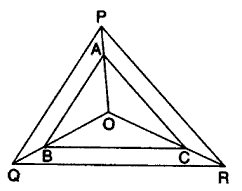
In figure $A, B$ and $C$ are points on $OP, OQ$ and $OR$ respectively such that $AB || PQ$ and $AC || PR$. Show that $BC || QR$.
Find the values of $x$ for which the distance between the point $P(2, -3)$, and $Q(x, 5)$ is $10.$
Represent the situation in the form of the quadratic equation:
A train travels a distance of $480\ km$ at a uniform speed. If the speed had been $8\  km/hr$ less, then it would have taken $3$ hours more to cover the same distance. We need to find the speed of the train.
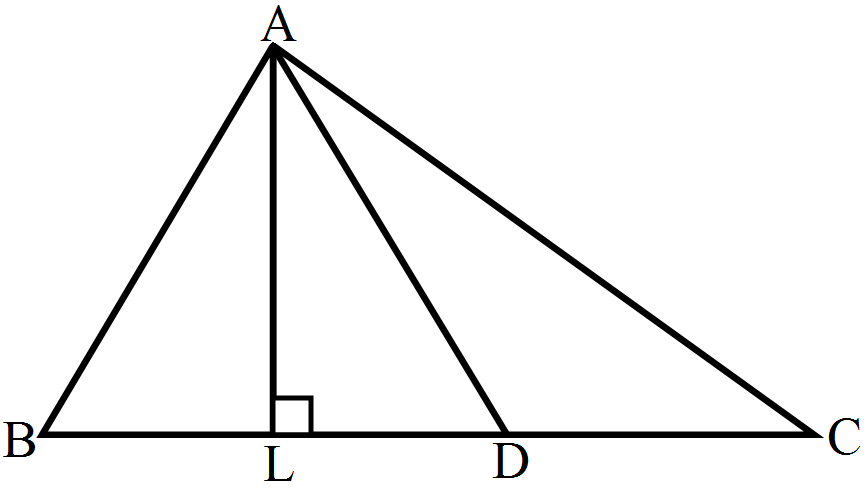
In a $\triangle\text{ABC},\text{AD}$ is a median and $\text{AL}\perp\text{BC}.$
Prove that:
  1. $\text{AC}^2=\text{AD}^2+\text{BC}.\text{DL}+\Big(\frac{\text{BC}}{2}\Big)^2$
  2. $\text{AB}^2=\text{AD}^2-\text{BC}.\text{DL}+\Big(\frac{\text{BC}}{2}\Big)^2$
  3. $\text{AC}^2+\text{AB}^2=2\text{AD}^2+\frac{\text{1}}{2}\text{BC}^2$
State $SSS$ similarity criterion.