Answer

  1. 50°
    Solution:
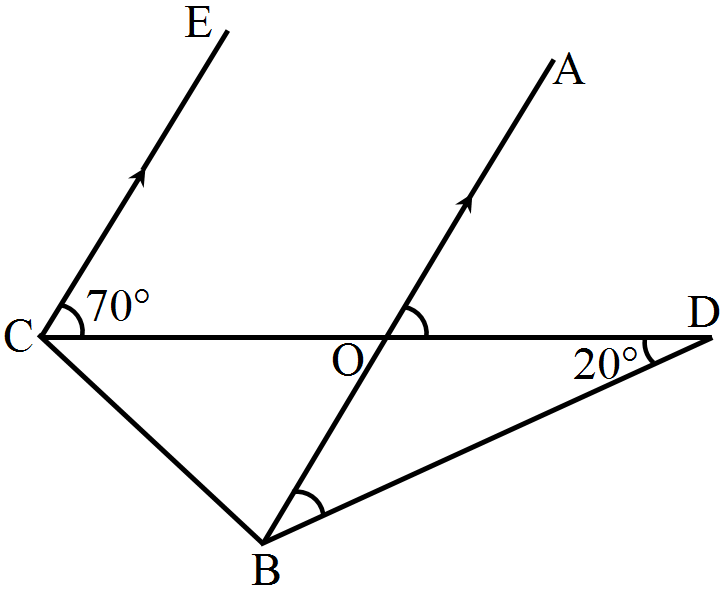
    $\text{EC}\ ||\text{ AB}$ and CD is transverse to it.
    Now $\angle\text{ECD} = \angle\text{AOD} = 70^\circ$ (Corresponding angles)
    In $\angle\text{OBD}$
    $\angle\text{OBD} + \angle\text{BOD} + \angle\text{ODB} = 180^\circ$
    $\angle\text{BOD} = 180^\circ - \angle\text{AOD} = 180^\circ - 70^\circ = 110^\circ$
    $\angle\text{ODB} = 20^\circ$ (Given)
    So, $\angle\text{OBD} = 180^\circ - \angle\text{BOD} - \angle\text{ODB}$
    $= 180^\circ - 110^\circ - 20^\circ$
    $= 50^\circ$

Need a full question paper?

Generate a complete, print-ready paper with questions like this in minutes — across 16+ boards, with answer keys.

Start Generating Free

Similar questions

If a + b + c = 0 then $\Big(\frac{\text{a}^2}{\text{bc}}+\frac{\text{b}^2}{\text{ca}}+\frac{\text{c}^2}{\text{ab}}\Big)=?$
If 10x - 4x2 - 3, then the value of p(0) + p(1) is:
An exterior angle of a triangle is $80^\circ$ and two interior opposite angles are equal. Measure of each of these angles is:
The value of (xa-b)a+b × (xb-c)b+c × (xc-a)c+a is:
Is || gm ABCD a square?
  1. Diagonals of || gm ABCD are equal.
  2. Diagonals of || gm ABCD intersect at right angles.
  1. If the question can be answered by one of the given statements alone and not by the other;
  2. If the question can be answered by either statement alone;
  3. If the question can be answered by both the statements together but not by any one of the two;
  4. If the question cannot be answered by using both the statements together.
$\sqrt{2}$ is a polynomial of degree.
Write the correct answer in the following:
The three steps from solids to points are:
  1. Solids - surfaces - lines - points.
  2. Solids - lines - surfaces - points.
  3. Lines - points - surfaces - solids.
  4. Lines - surfaces - points - solids.
The point on the graph of the linear equation $2 x+5 y=19$, whose ordinate is $1 \frac{1}{2}$ times its abscissa, is
A coin is tosses 1000 times, if the probability of getting a tail is $\frac{3}{8},$ how many times head is obtained?
  1. 525
  2. 375
  3. 625
  4. 725
In the following, write the correct answer.
In $\triangle\text{ABC}$ and $\triangle\text{PQR},$ if AB = AC, $\angle\text{C}=\angle\text{P}$ and $\angle\text{B}=\angle\text{Q}$ then the two triangles are:
  1. Isosceles but not congruent.
  2. Isosceles and congruent.
  3. Congruent abut not isosceles.
  4. Neither congruent nor isosceles.