Question
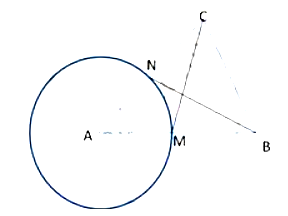
In following fig. ABC is an equilateral triangle . A circle is drawn with centre A so that ot cuts AB and AC at M and N respectively. Prove that BN = CM.
Answer

ABC is an equilateral triangle,
∴ AB = AC
Also AN = MB (radii of same circle)
⇒ NC = MB
In Δ BNC and Δ CMB
NC = MB (proved above)
∠ B = ∠ C (60° each)
BC = BC (common)
∴ Δ BNC and Δ CMB (SAS)
∴ BN = CM (CPCT)

Need a full question paper?

Generate a complete, print-ready paper with questions like this in minutes — across 16+ boards, with answer keys.
Start Generating Free

Similar questions

An A.P. consists of $60$ terms, If the first and the last terms be $7$ and $125$ respectively, find the $31^{st}$​​​​​​​ term.
The speed of the car is $66$ km/hour. If each wheel of the car is $140\ cm$ in diameter, find the number of revolutions made by each wheel per minute.
Prove that $\frac{1-\sin \theta}{1+\sin \theta}=(\sec \theta-\tan \theta)^2$
In each of the following, determine whether the given values are solution of the given equation or not:
$x^2-\sqrt{2}-4=0 ; x=-\sqrt{2}, x=-2 \sqrt{2}$
All the three face cards of spades are removed from a well shuffled pack of 52 cards. A card is then drawn at random from the remaining pack. Find the probability of getting:   a black face card 
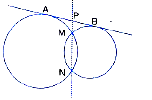
In the given figure, MN is the common chord of two intersecting circles and AB is their common tangent.

Prove that the line NM produced bisects AB at P.

Find the amount of bill for the following inter-state transaction of goods/services.

MRP (in Rs.) 12,000 15,000 9500 18,000
Discount % 30 20 30 40
CGST % 6 9 14 2.5
Two dice are thrown simultaneously. What is the probability that :
4 will not come up either time?
4 will come up at least once?
A man standing on the top of a vertical tower observes a car moving towards the tower at a uniform speed. If it takes 10 minutes for the angle of depression to change from 30° to 45°, how soon after this will the car reach the tower?
In a certain positive fraction, the denominator is greater than the numerator by 3. If 1 is subtracted from both the numerator and denominator, the fraction is decreased by$\frac{1}{14}$ Find the fraction.