Question
In general, the properties that decrease and increase down a group in the periodic table respectively are
Generate a complete, print-ready paper with questions like this in minutes — across 16+ boards, with answer keys.
${C_6}{H_5}N{H_2}\mathop {\xrightarrow{{NaN{O_2}/HCl}}}\limits_{0 - 5\,^o C} X\mathop {\xrightarrow{{HN{O_2}}}}\limits_{C{H_2}O} Y + {N_2} + HCl$
$X$ and $Y$ are respectively
$Cr _{2} O _{7}^{2-}+14 H ^{+}+6 e ^{-} \rightarrow 2 Cr ^{3+}+7 H _{2} O$
The amount of $Cr ^{3+}$ obtained was $0.104\, g$. The
efficiency of the process(in\%) is
(Take : $F =96000\, C$, At. mass of chromium $=52$ )
$A.$Reaction is spontaneous at $(a)$ and $(b)$
$B.$Reaction is at equilibrium at point $(b)$ and nonspontaneous at point $(c)$
$C.$Reaction is spontaneous at $(a)$ and nonspontaneous at $(c)$
$D.$Reaction is non-spontaneous at $(a)$ and $(b)$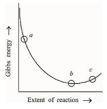
(Round off to the NearestInteger)
[Use:Atomicmasses:$Na:23.0\,u \mathrm{O}: 16.0 \,\mathrm{u} \quad \mathrm{H}: 1.0 \,\mathrm{u}$, Density of $\mathrm{H}_{2} \mathrm{O}: 1.0 \,\mathrm{~g} \,\mathrm{~cm}^{-3}$ ]