MCQ
In graphite, electrons are
- ALocalised on every third $C$ atom
- BPresent in antibonding orbital
- CLocalised on each $C$ atom
- ✓Spread out between the structure
Generate a complete, print-ready paper with questions like this in minutes — across 16+ boards, with answer keys.
${ }^{-} \mathrm{OH}, \mathrm{R} \overline{\mathrm{O}}, \mathrm{CH}_3 \mathrm{CO} \overline{\mathrm{O}}, \mathrm{C} \overline{1}$


| $I.E.\, (kJ \,mol^{-1})$ | $I.E.\, (kJ\, mol^{-1})$ |
| $A_{(g)} \to A^+_{(g)}+e^-,$ $A_1$ | $B_{(g)} \to B^{+}_{(g)}+e^-,$ $B_1$ |
| $B^+_{(g)} \to B^{2+}_{(g)}+e^-,$ $B_2$ | $C_{(g)} \to C^{+}_{(g)}+e^-,$ $C_1$ |
| $C^+_{(g)} \to C^{2+}_{(g)}+e^-,$ $C_2$ | $C^{2+}_{(g)} \to C^{3+}_{(g)}+e^-,$ $C_3$ |
If monovalent positive ion of $A,$ divalent positive ion of $B$ and trivalent positive ion of $C$ have zero electron. Then incorrect order of corresponding $I.E.$ is
Statement $I$ : Gallium is used in the manufacturing of thermometers.
Statement $II$ : A thermometer containing gallium is useful for measuring the freezing point ( $256 \mathrm{~K}$ ) of brine solution.
In the light of the above statement, choose the correct answer from the options given below :
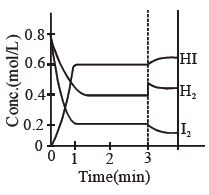
At the instant $3$ min, what change was imposed into the equilibrium ?