MCQ
In helium nucleus, there are
  • A
    $2$ protons and $2$ electrons
  • B
    $2$ neutrons, $ 2$ protons and $2$ electrons
  • $2$ protons and $2$ neutrons
  • D
    $2$ positrons and $2$ protons

Answer

Correct option: C.
$2$ protons and $2$ neutrons
c
(c) Helium nucleus $→ _2H{e^4}$.
Number of protons $= Z = 2$
Number of Neutrons $= A -Z = 2.$

Need a full question paper?

Generate a complete, print-ready paper with questions like this in minutes — across 16+ boards, with answer keys.

Start Generating Free

Similar questions

$Assertion$ : Space rocket are usually launched in the equatorial line from west to east
$Reason$ : The acceleration due to gravity is minimum at the equator.
A car is going round a circle of radius $R_1$ with constant speed. Another car is going round a circle of radius $R_2$ with constant speed. If both of them take same time to complete the circles, the ratio of their angular speeds and linear speeds will be .........
A particle starting from rest, moves in a circle of radius $r$. It attains a velocity of $\mathrm{V}_{0} \;\mathrm{m} / \mathrm{s}$ in the $\mathrm{n}^{\text {th }}$ round. Its angular acceleration will be
A galvanometer of resistance $100\,\Omega $ has $50\, divisions$ on its scale and has sensitivity of $20\,\mu A / division$. It is to be converted to a voltmeter with three ranges, of $0-2\, V$, $0-10\, V$ and $0-20\, V$. The appropriate circuit to do so is
$Assertion$ : A body with constant acceleration always moves along a straight line.

$Reason$ : A body with constant acceleration may not speed up.
An ice cube at temperature $-20^o C$ is kept in a room at temperature $20^o C$. The variation of temperature of the body with time is given by
Choose the correct statement
In an a.c. circuit, voltage and current are given by: $V=100 \sin (100 t)\  V$ and $I=100 \sin \left(100 t+\frac{\pi}{3}\right)\  \mathrm{mA}$ respectively. The average power dissipated in one cycle is:
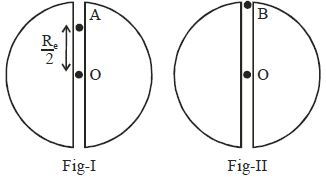
In both figures shown below a hole along the diameter of earth. In first, a particle is released from $A$ and it oscillated with time period $T_1$. In second figure, same particle is released from point $B$ and it oscillates with time period $T_2$ then [$O$ is centre of earth]
The orbital angular momentum of a satellite revolving at a distance $r$ from the centre is $L$. If the distance is increased to $16r$, then the new angular momentum will be