Question
In intrinsic semiconductors:

Answer

  1. n = p
Explanation:
Intrinsic semiconductors are pure ones. Hence there is no question of impurity. Valence band is the range of energy of electrons which are in the valence shell of the atoms of a substance. Conduction band is the range of energy of electrons which are free and available for conduction.
At room temperature, some electrons of intrinsic semiconductors get excited and reach the conduction band. During this process, the electrons leave empty spaces in the valence shell. These empty spaces are known as holes in a semiconductor. Number of free electrons (n) is equal to the number of holes (p).

Need a full question paper?

Generate a complete, print-ready paper with questions like this in minutes — across 16+ boards, with answer keys.
Start Generating Free

Similar questions

The magnetic flux linked with a coil is $\phi\leq8\text{t}^2+3\text{t}+5$ Weber. The induced emf in fourth second will be.
Assertion : $ A P-N$ photodiode is made from a semiconductor for which $E_g = 2.8 eV$. This photo diode will not detect the wavelength of $6000 \ nm.$
Reason    : A $PN$ photodiode detect wavelength $l$ if $\frac{\mathrm{hc}}{\lambda}>\mathrm{E}_{\mathrm{e}}$.
Which of the following statement is incorrect(a) Both ac and dc dynamo have a field magnet(b) Both ac and dc dynamo have an armature(c) Both ac and dc dynamo convert mechanical energy into electrical energy(d) Both ac and dc dynamo have slip rings


The ratio of specific charge of an α -particle to that of a proton is(a) 2 : 1(b) 1 : 1(c) 1 : 2(d) 1 : 3
       
The work done in bringing a 20 coulomb charge from point A to point B for distance 0.2m is 2J. The potential difference between the two points will be (in volt)(a) 0.2(b) 8(c) 0.1(d) 0.4
       
If the energy of the photon is increased by a factor of 4, then its momentum(a) Does not change(b) Decreases by a factor of 4(c) Increases by a factor of 4(d) Decreases by a factor of 2
   
   
A copper voltameter is connected in series with a heater coil of resistance 0.1 Ω. A steady current flows in the circuit for twenty minutes and mass of 0.99 g of copper is deposited at the cathode. If electrochemical equivalent of copper is 0.00033 gm/C, then heat generated in the coil is(a) 750 J  (b) 650 J(c) 350 J  (d) 250 J
       
Kinetic energy of emitted cathode rays is dependent on(a) Only voltage(b) Only work function(c) Both (a) and (b)(d) It does not depend upon any physical quantity


Potential energy is the characteristic of the:
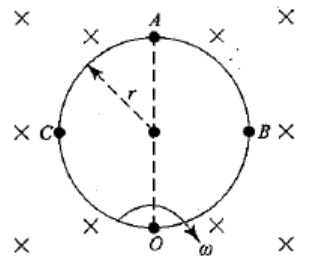
In figure, there is a conducting ring having resistance $R$ placed in the plane of paper in a uniform magnetic field $B_0​$. If the ring is rotating in the plane of paper about an axis passing through point $O$ and perpendicular to the plane of paper with constant angular speed $\omega$ in clockwise direction, then.
Image