MCQ
In isolated system, find the condition for spontaneous reaction.
  • A
    $\Delta U =0, \,\Delta S =0,\, \Delta G =0$
  • B
    $\Delta U < 0 , \,\Delta S > 0, \,\Delta G < 0 $
  • C
    $\Delta U =0,\, \Delta S > 0,\, \Delta G < 0$
  • $\Delta U < 0,\, \Delta S < 0,\, \Delta G < 0$
Answer

Correct option: D.
$\Delta U < 0,\, \Delta S < 0,\, \Delta G < 0$
d
For an isolated system, the change in energy $(\Delta U )$ remains zero.

For a spontaneous reaction, change in entropy $(\Delta S )$ remains greater than zero and change in free energy $(\Delta G )$ remains less than zero.

Need a full question paper?

Generate a complete, print-ready paper with questions like this in minutes — across 16+ boards, with answer keys.

Start Generating Free

Similar questions

The molar solubility of $Cd(OH)_2$ is $1.84\times10^{-5}\, M$ in water. The expected solubility of $Cd(OH)_2$ in a buffer solution of $pH = 12$ is
$10$ $d{m^3}$of ${N_2}$ gas and $10$ $d{m^3}$ of gas $X$ at the same temperature contain the same number of molecules. The gas $X$ is
Colour is imported to glass by mixing
Benzene burns according to the following equation at $300\, K$ $(R = 8.314\, J\, mole^{-1}K^{-1}), 2C_6H_6(l) + 15 O_2 (g) \to  12 CO_2 (g) + 6H_2O(l)$, $\Delta H^o = -6542\, kJ/mol$ What is the $\Delta E^o$ for the combustion of $1.5\, mol$ of benzene.....$kJ$
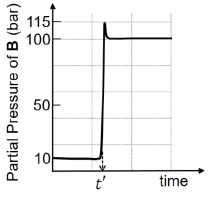
Consider the reaction $A \rightleftharpoons B$ at $1000 K$. At time $t ^{\prime}$, the temperature of the system was increased to $2000 K$ and the system was allowed to reach equilibrium. Throughout this experiment the partial pressure of $A$ was maintained at $1$ bar. Given below is the plot of the partial pressure of B with time. What is the ratio of the standard Gibbs energy of the reaction at $1000 K$ to that at $2000 K$ ?
Which of the following is the weakest acid
$\begin{array}{*{20}{c}}
  {C{H_3}\,\,\,\,\,\,\,\,\,\,\,\,\,\,\,\,\,\,\,\,\,} \\ 
  {|\,\,\,\,\,\,\,\,\,\,\,\,\,\,\,\,\,\,\,\,\,\,\,\,\,} \\ 
  {C{H_3} - CH + {H_2}C = C{H_2}} \\ 
  {|\,\,\,\,\,\,\,\,\,\,\,\,\,\,\,\,\,\,\,\,\,\,\,\,\,} \\ 
  {C{H_3}\,\,\,\,\,\,\,\,\,\,\,\,\,\,\,\,\,\,\,\,} 
\end{array}\xrightarrow[{{{2.5}\,^o}C}]{{HF}}(A) ; (A)$ is
Free energy change for the process A(s) ⇌ B(l) will be:
Given that
$2C(s) + 2O_2(g) \to 2CO_2(g) ; \Delta H = -787\, kJ$
$H_2(g) + \frac{1}{2} O_2(g) \to H_2O(l) ; \Delta H = -286 \,kJ$
$C_2H_2(g) + 2 \frac{1}{2} O_2(g) \to 2CO_2(g) + H_2O(l)$ ;
$\Delta H = -1301\, kJ$
Heat formation of acetylene is .....$kJ$
Which of the following order is not correct?