MCQ
In isothermal, isobaric and adiabatic processes, the value of work done for equal volume change is minimum:
  • A
    Isothermal
  • B
    Isobaric
  • Adiabatic
  • D
    None of these

Answer

Correct option: C.
Adiabatic
C

Need a full question paper?

Generate a complete, print-ready paper with questions like this in minutes — across 16+ boards, with answer keys.
Start Generating Free

Similar questions

A source of sound and listener are approaching each other with a speed of $40 m/s.$ The apparent frequency of note produced by the source is $400 \,cps$. Then, its true frequency (in $cps$) is (velocity of sound in air $= 360 m/s$)
A circular disc $X$ of radius $R$ is made from an iron plate of thickness $t$, and another disc $Y$ of radius $4R$ is made from an iron plate of thickness $\frac{t}{4}$.  Then the relation between the moment of inertia  ${I_x}$ and  ${I_y}$ is
A capillary tube of radius $r$ is immersed in water and water rises in it to a helght $h$. The mass of the water in the capillary is $5\,g.$ Another capillary tube of radlus $2\, r$ is immersed in water. The mass of water that will rise in this tube is $........\;g$
If $1\; g$ of steam is mixed with $1\; g$ of ice, then the resultant temperature of the mixture is ........ $^oC$
Potential energy of a person is minimum when:
The $x-t$ graph representing an object at rest is:
If satellite is shifted towards the earth. Then time period of satellite will be
Which of the following $($referred to a spherical mirror$)$ do $($does$)$ not depend on whether the rays are paraxial or not?
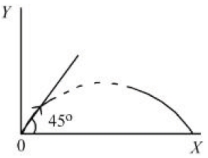
A particle of mass $100\,g$ is projected at time $t =0$ with a speed $20\,ms ^{-1}$ at an angle $45^{\circ}$ to the horizontal as given in the figure. The magnitude of the angular momentum of the particle about the starting point at time $t=2\,s$ is found to be $\sqrt{ K }\,kg\,m ^2 / s$. The value of $K$ is $............$ $\left(\right.$ Take $\left.g =10\,ms ^{-2}\right)$
A particle returns to the starting point after $10\,s$. If the rate of change of velocity during the motion is constant, then its location after $7\,s$ will be same as that after $...........\,s$