MCQ
In Kjeldahl’s method, the nitrogen present in the organic compound is quantitatively converted into
  • A
    Gaseous ammonia
  • B
    Ammonium sulphate
  • C
    Ammonium phosphate
  • Ammonia

Answer

Correct option: D.
Ammonia
d
(d) In Kjeldahl’s method, the nitrogen is estimated in the form of ammonia, which is obtained by heating compounds with $NaOH$.

$C{H_3}CON{H_2} + NaOHC \overset {\Delta} \longrightarrow {H_3}COONa + {H_2}O + N{H_3}$

Need a full question paper?

Generate a complete, print-ready paper with questions like this in minutes — across 16+ boards, with answer keys.

Start Generating Free

Similar questions

The volumes of two $HCl$ solutions $A(0.5\, M)$ and $B(0.1\, M) $ to be mixed for  preparing $2\,L$ of $0.2\, M \,HCl$ are
Which of the following gas does not have an octet or eight electrons in the outer shell
Atmosphere of big cities is polluted most by :
The maximum valency of an element with atomic number $7$ is
When the value of azimuthal quantum number is $3$ , magnetic quantum number can have values
In Lassaigne's extract of an organic compound, both nitrogen and sulphur are present, which gives blood red colour with $Fe ^{3+}$ due to the formation of-
The first four $I.E.$ values of an element are $284, 412, 656$ and $3210\, k.J\, mol^{-1}.$  The number of valence electrons in the element are
The equilibrium constants for the reaction, $\text{Zn(s)}+\text{Cu}^{2+}(\text{aq})\rightleftharpoons\text{Zn}^{2+}(\text{aq})+\text{Cu}(\text{s})$ and
$\text{Cu(s)}+2\text{Ag}^+(\text{aq})\rightleftharpoons\text{Cu}^{2+}(\text{aq})+2\text{Ag(s)}$ are $\text{K}_1$ and $\text{K}_2$ respectively. The equilibrium constant for the combined reaction is,
$X_{g} \to X^+_{(g)} +e^-,$               $\Delta\, H = +720 \, kJ \, mol^{-1}$

Calculate the amount of energy required to convert $110\, mg$ of $'X'$ atom in  gaseous state into $X^+$ ion .................... $\mathrm{kJ}$   (Atomic wt. for $X = 7\, g/mol$)

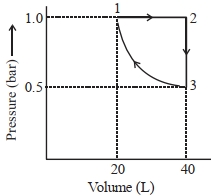
One mole of an ideal monoatomic gas is subjected to changes as shown in the graph. The magnitude of the work done (by the system or on the system) is $...........J$ (nearest integer).

Given : $\log 2=0.3, \ln 10=2.3$