MCQ
In LCR series AC circuit.
- AIf R is increased current will decrease.
- BIf L is increased current will decrease.
- CIf C is increased current will increase.
- DIf C is increased current will decrease.
Explanation:
$\text{I}=\frac{\text{V}}{\text{Z}}=\frac{\text{V}}{\sqrt{\text{R}^2\Big(\omega\text{L }\sim}\frac{1}{\omega\text{C}}\Big)^2}$
By increasing R, current will definitely decrease by change in L or C, current may increase or decrease.
Generate a complete, print-ready paper with questions like this in minutes — across 16+ boards, with answer keys.
An electron changes its position from orbit n = 4 to the orbit n = 2 of an atom. The wavelength of the emitted radiation’s is (R = Rydberg’s constant)
(a) 
|
(b) 
|
(c) 
|
(d) 
|
The plane faces of two identical plano-convex lenses each having focal length of 40 cm are pressed against each other to form a usual convex lens. The distance from this lens, at which an object must be placed to obtain a real, inverted image with magnification one is
|
(a) 80 cm |
(b) 40 cm |
(c) 20 cm |
(d) 162 cm |
In order to see diffraction the thickness of the film is
|
(a) 100 Å |
(b) 10,000 Å |
(c) 1 mm |
(d) 1 cm |
A nichrome wire 50 cm long and one square millimetre cross-section carries a current of 4A when connected to a 2V battery. The resistivity of nichrome wire in ohm metre is
|
(a) 1 |
(b) 4 |
(c) 3 |
(d) 2 |
Two metallic charged spheres whose radii are 20 cm and 10 cm respectively, have each 150 micro - coulomb positive charge. The common potential after they are connected by a conducting wire is
|
(a) 9 × |
(b) 4.5 × |
(c) 1.8 × |
(d) 13.5 × |
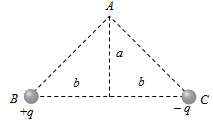
As shown in the figure, charges +q and -q are placed at the vertices B and C of an isosceles triangle. The potential at the vertex A is
|
(a) |
(b) Zero |
(c) |
(d) |
Two condensers of capacities 2C and C are joined in parallel and charged upto potential V. The battery is removed and the condenser of capacity C is filled completely with a medium of dielectric constant K. The p.d. across the capacitors will now be
|
(a) |
(b) |
(c) |
(d) |
Unit of magnetic permeability is
|
(a) Amp/metre |
(b) Amp/ |
(c) Henry |
(d) Henry/metre |