MCQ
In $LiAlH_4,$ metal $Al$ is present in
- ✓anionic part
- Bcationic part
- Cin both anionic and cationic part
- Dneither in cationic nor in anionic part
Therefore metal Al is present in anionic part.
Hence correct option is ( $\mathrm{A}$ ).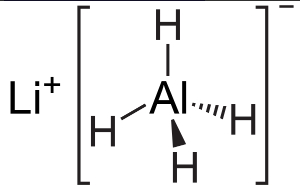
Generate a complete, print-ready paper with questions like this in minutes — across 16+ boards, with answer keys.
$\begin{array}{*{20}{c}}
{\begin{array}{*{20}{c}}
{\,\,{R_1}} \\
|
\end{array}} \\
{R - C - X} \\
| \\
{\,\,{R_2}}
\end{array}\xrightarrow{{HOH}}\begin{array}{*{20}{c}}
{\begin{array}{*{20}{c}}
{\,\,{R_1}} \\
|
\end{array}\,\,\,\,\,} \\
{R - C - OH} \\
{|\,\,\,} \\
{{R_2}}
\end{array}$
Which substrate will give maximum racemisation?
The order of the energies would be :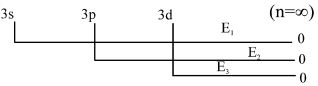
Reason : $NH_3$ is non-polar.
$(i)$ $\begin{gathered}
HCN\left( {aq} \right) + {H_2}O\left( l \right) \rightleftharpoons {H_3}{O^ + }\left( {aq} \right) + C{N^ - }\left( {aq} \right) \hfill \\
{K_a} = 6.2 \times {10^{ - 10}} \hfill \\
\end{gathered} $
$(ii)$ $\begin{gathered}
C{N^ - }\left( {aq} \right) + {H_2}O\left( l \right) \rightleftharpoons HCN\left( {aq} \right) + O{H^ - }\left( {aq} \right) \hfill \\
{K_b} = 1.6 \times {10^{ - 5}} \hfill \\
\end{gathered} $
These equilibria show the following order of the relative base strength