Question
In long range transmission, why micro waves are better carrier than radio waves?

Answer

In long range transmission, micro waves are better carrier than radio waves because their wavelength is very less as compared to radio waves. Due to this, during obstruction, they suffer minimum deviation and can be sent directly towards the aim.

Need a full question paper?

Generate a complete, print-ready paper with questions like this in minutes — across 16+ boards, with answer keys.

Start Generating Free

Similar questions

Explain the uses of Polaroid.
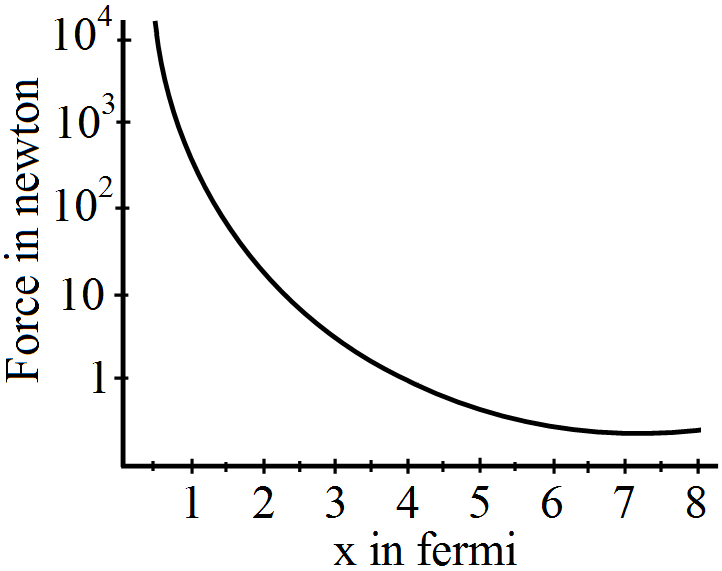
Suppose the magnitude of Nuclear force between two protons varies with the distance between them as shown in figure. Estimate the ratio "Nuclear force Coulomb force" for:
  1. $x = 8fm$
  2. $x = 4fm$
  3. $x = 2fm$
  4. $x = 1fm (1fm = 10^{-15}m). $
Name the device used for measuring the internal resistance of a secondary cell.
A metal block of density $6000\ kg m^{-3}$ and mass $1.2\ kg$ is suspended through a spring of spring constant $200N m^{-1}$. The spring-block system is dipped in water kept in a vessel. The water has a mass of $260g$ and the block is at a height $40\ cm$ above the bottom of the vessel. If the support to the spring is broken, what will be the rise in the temperature of the water. Specific heat capacity of the block is $250J\ kg^{-1} K^{-1}$ and that of water is $4200J\ kg^{-1} K^{-1}$. Heat capacities of the vessel and the spring are negligible.
The normal duration of $I.Sc.$ Physics practical period in Indian colleges is $100$ minutes. Express this period in microcenturies. $1$ microcentury $= 10^{-6} \times 100$ years. How many microcenturies did you sleep yesterday?
A point charge $Q$ is placed at point $‘O\ ’$ as shown in the figure. Is the potential at point $A,$ i.e.$ V_A,$ greater, smaller or equal to potential,$ V_B,$ at point $B,$ when $Q$ is $(i)$ positive, and $(ii)$ negative charge?
Why can't we see clearly through fog? Name the phenomenon responsible for it.
Show that moment of inertia of a solid body of any shape changes with temperature as $\text{I}=\text{I}_0(1+2\alpha\theta),$ where $\text{I}_0$ is the moment of inertia at $0^\circ C$ and a is the coefficient of linear expansion of the solid.
For transistor action, which of the following statements are correct:
  1. Base, emitter and collector regions should have similar size and doping concentrations.
  2. The base region must be very thin and lightly doped.
  3. The emitter junction is forward biased and collector junction is reverse biased.
  4. Both the emitter junction as well as the collector junction are forward biased.
Define the term electric dipole moment. Is it a scalar or a vector quantity?