Question
In metals ____ are the mobile charges.

Answer

  1. Electrons.

Need a full question paper?

Generate a complete, print-ready paper with questions like this in minutes — across 16+ boards, with answer keys.

Start Generating Free

Similar questions

Match the List I with the List II from the combinations shown
(I) Presbiopia (A) Sphero-cylindrical lens
(II) Hypermetropia (B) Convex lens of proper power may be used close to the eye
(III) Astigmatism (C) Concave lens of suitable focal length
(IV) Myopia (D) Bifocal lens of suitable focal length
(a) I-A; II-C; III-B; IV-D(b) I-B; II-D; III-C; IV-A(c) I-D; II-B; III-A; IV-C(d) I-D; II-A; III-C; IV-B
       
In the hydrogen atom, an electron makes a transition from $n = 2$ to $n = 1$. The magnetic field produced by the circulating electron at the nucleus?
The radiant energy of the sun results from:
In a step-up transformer the turn ratio is 1:10. A resistance of 200 ohm connected across the secondary is drawing a current of 0.5 A. What is the primary voltage and current
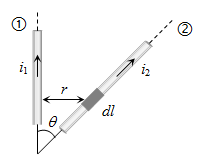
Wires $1$ and $2$ carrying currents $i_1$ and $i_2$ respectively are inclined at an angle $\theta$ to each other. What is the force on a small element dl of wire $2$ at a distance of $r$ from wire $1 ($as shown in figure$)$ due to the magnetic field of wire$1$
Energy in a current carrying coil is stored in the form of:
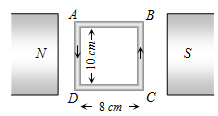
A $100$ turns coil shown in figure carries a current of $2$ amp in a magnetic field $B =0.2\ wb / m ^2$. The torque acting on the coil is
The potential at a distance $R / 2$ from the centre of a conducting sphere of radius $R$ will be
Which theory is confirmed by the Davisson – Germer experiment?
A particle moving in a magnetic field increases its velocity, then its radius of the circle(a) Decreases(b) Increases(c) Remains the same(d) Becomes half