MCQ
In MKS system, Stefan's constant is denoted by $\sigma$. In CGS system multiplying factor of $\sigma$ will be
  • A
    1
  • $10^3$
  • C
    $10^5$
  • D
    $10^2$

Answer

Correct option: B.
$10^3$
(b)
In M.K.S. system unit of $\sigma \text { is } \frac{\mathrm{J}}{\mathrm{m}^2 \times \sec \times K^4} $
$\Rightarrow = \frac{\mathrm{J}}{\mathrm{m^2\times\sec\times K^4}}=\frac{10^7 \mathrm{erg}}{10^4 \mathrm{~cm}^2 \times \sec \times K^4} $
$=10^3 \frac{\mathrm{erg}}{\mathrm{cm}^2 \times \sec \times K^4}$

Need a full question paper?

Generate a complete, print-ready paper with questions like this in minutes — across 16+ boards, with answer keys.
Start Generating Free

Similar questions

A spherical source of power $4 \mathrm{~W}$ and frequency $800 \mathrm{~Hz}$ is emitting sound waves. The intensity of waves at a distance $200 \mathrm{~m}$ is
If velocity of a body is twice of previous velocity, then kinetic energy will become
If $n_e$ and $n_h$ are the number of electrons and holes in a semiconductor heavily doped with phosphorus, then
If the Young's modulus of the material is 3 times its modulus of rigidity, then its volume elasticity will be
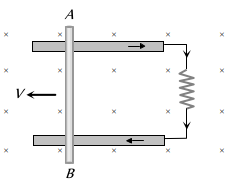
Consider the situation shown in the figure. The wire $A B$ is sliding on the fixed rails with a constant velocity. If the wire $A B$ is replaced by semicircular wire, the magnitude of the induced current will

Image

A galvanometer coil has $500$ turns and each turn has an average area of $3 \times 10^{-4}\, m ^{2}$. If a torque of $1.5\,Nm$ is required to keep this coil parallel to magnetic field when a current of $0.5\, A$ is flowing through it, the strength of the field (in $T )$ is
A gas for which $\gamma=1.5$ is suddenly compressed to $\frac{1}{4}$ th of the initial volume. Then the ratio of the final to the initial pressure is
The radius of hydrogen atom in its ground state is $5.3 \times 10^{-11}\ m$. After collision with an electron it is found to have a radius of
Two metal strips that constitute a thermostat must necessarily differ in their
The focal lengths of the objective and the eye-piece of a compound microscope are $2.0 \mathrm{~cm}$ and $3.0 \mathrm{~cm}$ respectively. The distance between the objective and the eye-piece is $15.0 \mathrm{~cm}$. The final image formed by the eye-piece is at infinity. The two lenses are thin. The distances in $\mathrm{cm}$ of the object and the image produced by the objective measured from the objective lens are respectively