MCQ
In optical bench experiment index error is $+1\ cm$ and $-1\ cm$ , between object needle and lens, lens and image needle respectively. Observed values of $u$ and $v$ are $9\ cm$ and $17\ cm$ . Focal length of lens is .....$cm$
  • A
    $6.15$
  • $5.54$
  • C
    $5.88$
  • D
    $6.25$

Answer

Correct option: B.
$5.54$
b
Index error in $\mathrm{u}=+1 \mathrm{\,cm}$

$\mathrm{u}=8 \mathrm{\,cm}$

index error in $\mathrm{v}=-1 \mathrm{\,cm}$

$v=17+1=18 \mathrm{\,cm}$

$\frac{1}{f}=\frac{1}{18}+\frac{1}{8}$

$\mathrm{f}=5.53 \mathrm{\,cm}$

Need a full question paper?

Generate a complete, print-ready paper with questions like this in minutes — across 16+ boards, with answer keys.

Start Generating Free

Similar questions

The masses and radii of the earth and the moon are $M_1$, $R_1$ and $M_2$,$R_2$ respectively. Their centres are distance $d$ apart. The minimum speed with which particle of mass m should be projected from a point midway between the two centres so as to escape to infinity is :
Which is correct relation
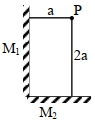
Two plane mirrors ${M}_{1}$ and ${M}_{2}$ are at right angle to each other shown. A point source $'P'$ is placed at $'a'$ and $'2a'$ meter away from ${M}_{1}$ and ${M}_{2}$ respectively. The longest distance between the images thus formed is : (Take $\sqrt{5}=2.3$ )
The transition from the state $n = 4$ to $n = 3$ in a hydrogen like atom results in ultraviolet radiation. Infrared radiation will be obtained in the transition from
An object suspended by a wire stretches it by $10 \,mm$. When object is immersed in a liquid the elongation in wire reduces by $\frac{10}{3} \,mm$. The ratio of relative densities of the object and liquid is $............$
A body of mass $2\,kg$ is moving with velocity $10 \,m/s$ towards east. Another body of same mass and same velocity moving towards north collides with former and coalsces and moves towards north-east. Its velocity is
The pressure and density of a diatomic gas $(\gamma = 7/5)$ change adiabatically from $(P, d)$ to $(P', d')$. If $\frac{{d'}}{d} = 32$, then $\frac{{P'}}{P}$ should be
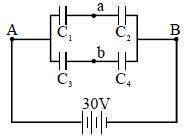
Four capacitors with capacitances $C_1 = 1\,\mu F, C_2 = 1.5\,\mu F, C_3 = 2.5\,\mu F$ and $C_4 = 0.5\,\mu F$ are connected as shown and are connected to a $30\, volt$ source. The potential difference between points $a$ and $b$ is.....$V$
The angle of prism is $5^o$ and its refractive indices for red and violet colours are $1.5$ and $1.6$ respectively. The angular dispersion produced by the prism is.....$^o$
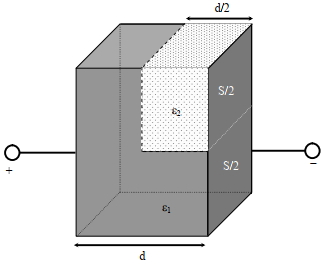
A parallel plate capacitor having plates of area $S$ and plate separation $d$, has capacitance $C _1$ in air. When two dielectrics of different relative permittivities $\left(\varepsilon_1=2\right.$ and $\left.\varepsilon_2=4\right)$ are introduced between the two plates as shown in the figure, the capacitance becomes $C _2$. The ratio $\frac{ C _2}{ C _1}$ is