Question
In optical instruments, the lenses are used to form images by:

Answer

  1. Refraction
Explanation:
In optical instruments, the lenses are used to form images by Refraction.

Need a full question paper?

Generate a complete, print-ready paper with questions like this in minutes — across 16+ boards, with answer keys.
Start Generating Free

Similar questions

Two identical light sources $S_1$ and $S_2$ emit light of same wavelength $\lambda$. These light rays will exhibit interference if
A double charged lithium atom is equivalent to hydrogen whose atomic number is $3.$ The wavelength of required radiation for emitting electron from first to third Bohr orbit in $Li^{++}$ will be $($Ionisation energy of hydrogen atom is $13.6e\ V)$
The dimensions of surface charge density is:
A magnet makes $40$ oscillations per minute at a place having magnetic field intensity of $0.1 \times 10^{–5} T$. At another place, it takes $2.5 \sec$ to complete one vibration. The value of earth’s horizontal field at that place is
Two capacitors of capacitances 3 μF  and 6 μF  are charged to a potential of 12 V each. They are now connected to each other, with the positive plate of each joined to the negative plate of the other. The potential difference across each will be (a) 6 volt(b) 4 volt(c) 3 volt (d) Zero
       
Antimony and bismuth are usually used in a thermocouple, because(a) Negative thermal e.m.f. produced(b) Constant thermal e.m.f. produced(c) Lower thermal e.m.f. produced(d) Higher thermal e.m.f. produced
   
   
The radius of a wavefront as the waves propagate:
In Young's double slit experiment, the distance between the two slits is $0.1\ mm$ and the wavelength of light used is $4 \times 10^{-7} m$ . If the width of the fringe on the screen is $4\ mm,$ the distance between screen and slit is
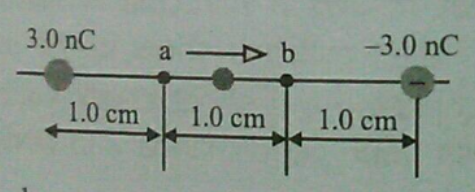
As shown in figure a dust particle with mass $m = 5.0 \times 10^{-9}\  kg$ and charge $q_{0 }= 2.0\ n\ C$ starts from rest at point a and moves in $a$ straight line to point $b.$ What is its speed $v $at point $b$?
The smallest temperature difference that can be measured with a combination of a thermocouple of thermo $\text{e.m.f.} \ 30\ mV$ per degree and a galvanometer of $50$ ohm resistance, capable of measuring a minimum current of $3 \times 10^{–7}$ amp is