MCQ
In order to increase the angular magnification of a simple microscope, one should increase:
- AThe object size
- BThe aperture of the lens
- CThe focal length of the lens
- DThe power of the lens
In order to increase the angular magnification of a simple microscope, one should increase:
Explanation:
When the image is formed at infinity
m = Df = DPm = Df = DP
when the image is formed at the near point
m = (1+Df) = 1 + DP
Generate a complete, print-ready paper with questions like this in minutes — across 16+ boards, with answer keys.
The plates of a capacitor are charged to a potential difference of 320 volts and are then connected across a resistor. The potential difference across the capacitor decays exponentially with time. After 1 second the potential difference between the plates of the capacitor is 240 volts, then after 2 and 3 seconds the potential difference between the plates will be
|
(a) 200 and 180 V |
(b) 180 and 135 V |
(c) 160 and 80 V |
(d) 140 and 20 V |
Assertion : A double convex lens (m = 1.5) has focal length 10 cm. When the lens is immersed in water (m = 4/3) its focal length becomes 40 cm.
Reason : 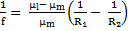
|
(a) If both assertion and reason are true and the reason is the correct explanation of the assertion. |
|
(b) If both assertion and reason are true but reason is not the correct explanation of the assertion. |
|
(c) If assertion is true but reason is false. |
|
(d) If the assertion and reason both are false. |
Energy of the electron in nth orbit of hydrogen atom is given by  . The amount of energy needed to transfer electron from first orbit to third orbit is
|
(a) 13.6 eV |
(b) 3.4 eV |
(c) 12.09 eV |
(d) 1.51 eV |
A freshly prepared radioactive sample of half- life 1 hour emits radiations that are 128 times as intense as the permissible safe limit. The minimum time after which this sample can be safely used is
|
(a) 14 hours |
(b) 7 hours |
(c) 128 hours |
(d) 256 hours |
An electron and a proton with equal momentum enter perpendicularly into a uniform magnetic field, then
|
(a) The path of proton shall be more curved than that of electron |
|
(b) The path of proton shall be less curved than that of electron |
|
(c) Both are equally curved |
|
(d) Path of both will be straight line |
Identify the wrong statement in the following. Coulomb's law correctly describes the electric force that
|
(a) Binds the electrons of an atom to its nucleus |
|
(b) Binds the protons and neutrons in the nucleus of an atom |
|
(c) Binds atoms together to form molecules |
|
(d) Binds atoms and molecules together to form solids |
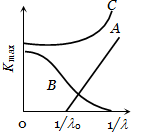
The correct graph between the maximum energy of a photoelectron and the inverse of wavelength of the incident radiation is given by the curve
|
(a) A |
(b) B |
(c) C |
(d) None of the above |