MCQ
In $P-N$ junction, avalanche current flows in circuit when biasing is
  • A
    Forward
  • Reverse
  • C
    Zero
  • D
    Excess

Answer

Correct option: B.
Reverse
b
(b)At a particular reverse voltage in $PN-$junction, a huge current flows in reverse direction known as avalanche current.

Need a full question paper?

Generate a complete, print-ready paper with questions like this in minutes — across 16+ boards, with answer keys.

Start Generating Free

Similar questions

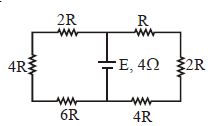
A battery of internal resistance $4\,\Omega $ is connected to the network of the resistance as shown in Fig. If the maximum power can be delivered to the network, the magnitude of $R$ in $\Omega $ should be
A scientist says that the efficiency of his heat engine which operates at source temperature $127°C$ and sink temperature $27°C$ is $26\%$, then
A fly wheel of moment of inertia $0.4\,\, kg\, m^2$ and radius $0.2\,\, m$ is free to rotate about a central axis. If a string is wrapped around it and it is pulled with a force of $10 \,N$ , then angular velocity after $4\,\, sec$ will be ......... $rad\,\,s^{-1}$.
A particle moves in the $x-y$ plane under the action of a force $\overrightarrow F $ such that the value of its linear momentum $(\overrightarrow P )$ at anytime t is ${P_x} = 2\cos t,\,{p_y} = 2\sin t.$ The angle $\theta $between $\overrightarrow F $ and $\overrightarrow P $ at a given time $t$. will be $\theta =$ ........... $^o$
In a biprism experiment, by using light of wavelength $5000 Å$, $5 \,mm$ wide fringes are obtained on a screen $1.0 \,m$ away from the coherent sources. The separation between the two coherent sources is.....$mm$
Ultraviolet light of wavelength $300 \ nm$ and intensity $1.0 \ watt/m^2$ falls on the surface of a photosensitive material. If $1\%$ of the incident photons produce photoelectrons, then the number of photoelectrons emitted from an area of $1.0\  cm^2$ of the surface is nearly
Which of the following statement is $NOT$ correct ?
Two forces $P + Q$ and $P -Q$ make angle $2 \alpha$ with each other and their  resultant make $\theta$ angle with bisector of angle between them. Then :
A battery of $3.0\, V$ is connected to a resistor dissipating $0.5\, W$ of power. If the terminal voltage of the battery is $2.5\, V$ the power dissipated within the internal resistance is$.......W$
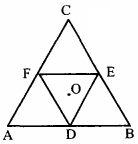
The equilateral triangle $ABC$ is cut from a thin solid sheet of wood. (See figure) $D, E$ and $F$ are the mid points of its sides as shown and $G$ is the centre of the triangle. The moment of inertia of the triangle about an axis passing through $G$ and perpendicular to the plane of the triangle is $I_0.$ If the smaller triangle $DEF$ is removed from $ABC,$ the moment of inertia of the remaining figure about the same axis is $I.$ Then