MCQ
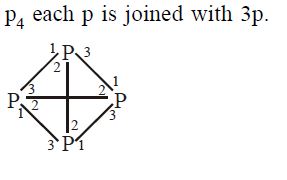
In $P_4$ (tetrahedral)
- AEach $P$ is joined to four $P$
- ✓Each $P$ is joined to three $P$
- CEach $P$ is joined to two $P$
- D$P_4$ does not exist
Generate a complete, print-ready paper with questions like this in minutes — across 16+ boards, with answer keys.
$[ C ]$ is $........$
The molar mass difference between compounds $Q$ and $R$ is $474 \mathrm{~mol}^{-1}$ and between compounds $P$ and $S$ is $172.5 \mathrm{~g} \mathrm{~mol}^{-1}$.
($1$)The number of heteroatoms present in one molecule of $R$ is. . . . . .
[Use: Molar mass (in g mol ${ }^{-1}$ ): $\mathrm{H}=1, \mathrm{C}=12, \mathrm{~N}=14, \mathrm{O}=16, \mathrm{Br}=80, \mathrm{Cl}=35.5$
Atoms other than $\mathrm{C}$ and $\mathrm{H}$ are considered as heteroatoms]
($2$)The total number of carbon atoms and heteroatoms present in one molecule of $S$. . . . . .
[Use: Molar mass in $\mathrm{g} \mathrm{mol}^{-1}$ ]: $\mathrm{H}=1, \mathrm{C}=12, \mathrm{~N}=14, \mathrm{O}=16, \mathrm{Br}=80, \mathrm{Cl}=35.5$
Atoms other than $\mathrm{C}$ and $\mathrm{H}$ are considered as heteroatoms
Give the answer quetion ($1$) and ($2$)