Question
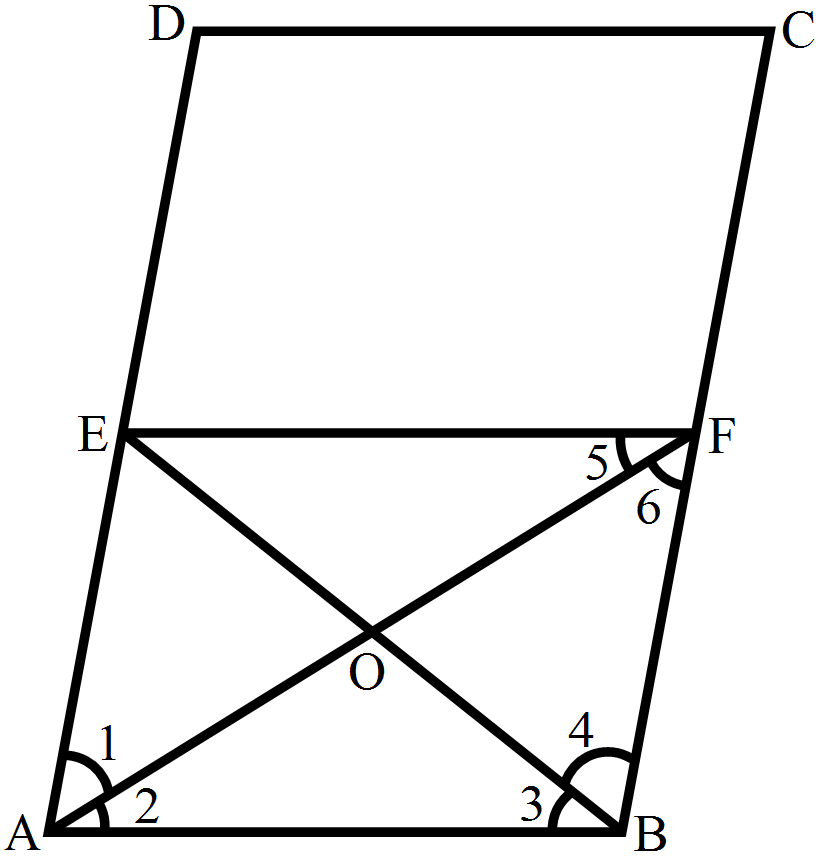
In parallelogram $ABCD$, the angle bisector of $\angle\text{A}$ bisects $BC$. Will angle bisector of $B$ also bisect $AD$? Give reason.
Answer

Given, $ABCD$ is a parallelogram, bisector of $\angle\text{A}$, bisects $BC$ at F i.e., $\angle\text{1}=\angle2,\text{CF}=\text{FB}$ Draw $FB\ ||\ BA$
$\therefore\text{ABFE}$ is a parallelogram by construction
$\angle1=\angle6$
But $\angle1=\angle2$ [given]
$\therefore\angle2=\angle6$
$AB = FB$ [opposite sides to equal angles are equal] $…(i)$
$\therefore\text{ABFE}$ is a rhombus.
Now, in $\triangle\text{ABO}\ \text{and}\ \text{BOF},\text{AB}=\text{FB}$ [from eq. $(i)$]
$BO = BO$ [common] $AO = FO$ [diagonals of rhombus bisect each other]
$\therefore\triangle\text{ABO}\cong\triangle\text{BOF}$ [by SSS]
$\angle3=\angle4$ [by $CPCT$]
Now, $BF =$$\frac{1}{2}\text{BC}$[given]
$\Rightarrow\text{BF}=\frac{1}{2}\text{AD}$ $[BC = AD]$
$\Rightarrow\text{AE}=\frac{1}{2}\text{AD}$$[BF = AE]$
$\therefore$ $E$ is the mid-point of $AD$.

Need a full question paper?

Generate a complete, print-ready paper with questions like this in minutes — across 16+ boards, with answer keys.

Start Generating Free

Similar questions

Find whether, or not the first polynomial is a factor of the second:
$\frac{3\text{y}^3+5\text{y}^2+5\text{y}+2}{\text{y}-2}$
Construct a quadrilateral $ABCD$, given that $AB = 8\ cm, BC = 8\ cm, CD = 10\ cm, AD = 10 \ cm$ and $\angle\text{A}=45^\circ.$
In $2007-08,$ the number of students appeared for Class X examination was $105332$ and in $2008-09,$ the number was $116054.$ If $88151$ students pass the examination in $2007-08$ and $103804$ students in $2008-09.$ What is the increase or decrease in pass$\%$ in Class X result?
Plot the points $(2, 8), (7, 8)$ and $(12, 8)$. Join these points in pairs. Do they lie on a line? What do you observe?
In a rectangle $ABCD$, $AB = 25\ cm$ and $BC = 15$. In what ratio does the bisector of $\angle\text{C}$ divide $AB$?
Construct a quadrilateral $ABCD,$ where$\angle\text{A}=65^\circ,\text{B}=105^\circ,\text{C}=75^\circ,$ $BC = 5.7$ and $CD = 6.8\ cm$.
Express the following numbers in usual form.
(i) $3.02 \times 10^{-6}$
(ii) $4.5 \times 10^4$
(iii) $3 \times 10^{-8}$
(iv) $1.0001 \times 10^9$
(v) $5.8 \times 10^{12}$
(vi) $3.61492 \times 10^6$
A bank gives $10\%$ simple interest on deposits by senior citizens. Draw a line graph to illustrate the relation between the sum deposited and the simple interest earned. Find from the graph:
$i.$ The annual interest obtainable for a investment of $Rs.250.$
$ii.$ The investment one has to make in order to get an annual simple interest of $Rs. 70.$
Find the ratio between the total surface area of a cylinder to its curved surface area, given that its height and radius are $7.5\ cm$ and $3.5\ cm$.
$\frac{5\text{x}}{3}+\frac{2}{5}=1$