MCQ
In photoelectric effect, stopping potential depends on
  • A
    frequency of the incident light
  • B
    intensity of the incident light by varies source distance
  • C
    emitter’s properties
  • $(A)$ and $(C)$ both

Answer

Correct option: D.
$(A)$ and $(C)$ both
d

Need a full question paper?

Generate a complete, print-ready paper with questions like this in minutes — across 16+ boards, with answer keys.

Start Generating Free

Similar questions

Consider a glass cube slab of dielectric bound by the planes $x=0, x=a ; y=0, y=b ; z=0, z=c$; with $b > a > c$. The slab is placed in air and has a refractive index of $n$. The minimum value for $n$, such that all rays entering the dielectric at $y=0$ reach $y=b$ is
The intensity of the field generated at a point due to an electric dipole is directly proportional to:
Assertion : Two electric bulbs of 50 and 100 W are given. When connected in series 50 W bulb glows more but when connected parallel 100 W bulb glows more.
Reason : In series combination, power is directly proportional to the resistance of circuit. But in parallel combination, power is inversely proportional to the resistance of the circuit.
The sensitivity of a Galvenometer of resistance $171\,\Omega $ becomes $20\,times$ when we used shunt of $x \,\Omega .$ Find $x$ ................. $\Omega$
An $\alpha -$ particle of $1\,MeV$ energy moves on circular path in uniform magnetic field. Then kinetic energy of proton in same magnetic field for circular path of double radius is......$MeV$
In a photoelectric effect experiment the threshold wavelength of incident light is $380\, nm$, If the wavelength of the incident light is $260\,nm$, the maximum kinetic energy of emitted electrons will be: .............. $eV$

Given $E$ (in $eV$) $ = \frac{{1237}}{{\lambda \left( {in\,nm} \right)}}$
Potential atapoint $A$ is $3 $ $ volt$ and atapoint $B$ is $7$ $volt$,an electron is moving towards $A$ from $B.$
A current carrying loop is placed in a uniform magnetic field. The torque acting on it does not depend upon:
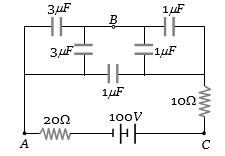
In the figure below, what is the potential difference between the point $A$ and $B$ and between $B$ and $C$ respectively in steady state
A ray of light is incident at an angle of $60^o$ on one face of a prism of angle $30^o$ . The emergent ray of light makes an angle of $30^o$  with incident ray. The angle made by the emergent ray with second face of prism will be....$^o$