Answer

  1. 6

Explanation:

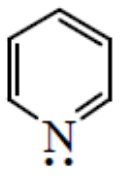
Pyridine is an aromatic compound because it follows Huckel's rule (4n + 2)$\pi$ electrons with 6π electrons within the ring.

These 6$\pi$ are responsible for conjugation over the ring by delocalization, therefore, it has a total of 6 conjugated electrons.

There is one lone pair present on N but if we consider those electrons in conjugation then total electrons would be 8 and the compound will become antiaromatic and least stable.

Hence, lone of electrons of N does not contribute in conjugation, hence not count.
Need a full question paper?

Generate a complete, print-ready paper with questions like this in minutes — across 16+ boards, with answer keys.

Start Generating Free

Similar questions

In which of the following reaction $H_2O_2$ is working as reducing agent ?
Which statement relating to the spectrum of $H$ atom is false :
According to Le-chatelier's principle, an increase in the temperature of the following reaction will

${N_2} + {O_2}$ $\rightleftharpoons$ $2NO - 43,200\,kcal$
At temperature, $T$, a compound $A{B_{2\left( g \right)}}$ dissociates according to the reaction; $2A{B_{2\left( g \right)}} \rightleftharpoons 2A{B_{\left( g \right)}} + {B_{2\left( g \right)}}$ with a degree of dissociation $x$, which is small compared with unity. The expression for $K_p$, in terms of $x$ and the total pressure, $P$ is
Pairing of electrons in the orbitals belonging to the same subshell (p, d or f) does not take place until each orbital belonging to that subshell is singly occupied. This is called:
Which of the following will not function as a buffer solution
A solution of optically active $1$ -phenylethanol racemizes in acidified aqueous  medium. It is due to
For the reaction ${N_{2(g)}} + {O_{2(g)}}$ $\rightleftharpoons$ $2N{O_{(g)}}$, the value of ${K_c}$ at ${800\,^o}C$ is $0.1$. When the equilibrium concentrations of both the reactants is $0.5\, mol,$ what is the value of ${K_p}$ at the same temperature
Carbongene has $X\%$ of $CO_2$ and is used as an antidote for poisoning of $Y.$ Then, $X$ and $Y$ are
Order of basic strength $\mathop {Ph - N{H_2},}\limits_{(A)} \,\,\mathop {Ph - NH - Me,}\limits_{(B)} \,\,\mathop {\begin{array}{*{20}{c}}
{Ph - N - Me}\\
|\\
{Me}
\end{array}}\limits_{(C)} $