Question
In Rutherford's scattering model, it is shown that : (i) mostly alpha particle passes direct linearly without scattering, (ii) while some scattered by making large angle and some of these after scattering returned back to their path. What is the information obtained from these about atomic structure?
Answer

(i) Maximum part is empty inside the atom.
(ii) Positive charge is conentrated at tiny space (nucleus) in atom.

Need a full question paper?

Generate a complete, print-ready paper with questions like this in minutes — across 16+ boards, with answer keys.

Start Generating Free

Similar questions

The coercive force for a certain permanent magnet is $4.0 \times 10^4A/m$. Thia magnet is placed inside a long solenoid of $40$ turns $/cm$ and a current is passed in the solenoid to demagnetise it completely. Find the current.
Show that moment of inertia of a solid body of any shape changes with temperature as $\text{I}=\text{I}_0(1+2\alpha\theta),$ where $\text{I}_0$ is the moment of inertia at $0^\circ C$ and a is the coefficient of linear expansion of the solid.
In a Young's doulbe-slit experiment, the slits are separated by 0.28 mm and the screen is placed 1.4 m away. The distance between the central bright fringe and the fourth bright fringe is measured to be 1.2 cm. Determine the wavelength of light used in the experiment.
A source with e.m.f. '$\varepsilon$'and internal resistance 'r' is combined with external resistance 'R'. Write the value of voltage on resistance R.
Define one ampere in international unit system.
Can X-rays be polarized?
Answer carefully:
A small test charge is released at rest at a point in an electrostatic field configuration. Will it travel along the field line passing through that point?
Two spherical bobs, one metallic and the other of glass, of the same size are allowed to fall freely from the same height above the ground. Which of the two would reach earlier and why?
What is the geometrical shape of equipotential surfaces due to a single isolated charge?
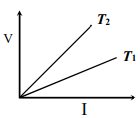
The voltage V and current I graph for a conductor at two different temperatures $T _1$ and $T _2$ are shown in the figure. Which of the highest value of temperature $T _1$ and $T _2$ is more and why?
Image