Question
In square $\text{ABCD}; A = (3, 4), B = (-2, 4)$ and $C = (-2, -1)$. By plotting these points on a graph paper, find the co$-$ordinates of vertex $D$. Also, find the area of the square.
Answer

Given that in square $\text{ABCD} ; A(3,4), B(-2,4)$ and $C(-2,-1)$

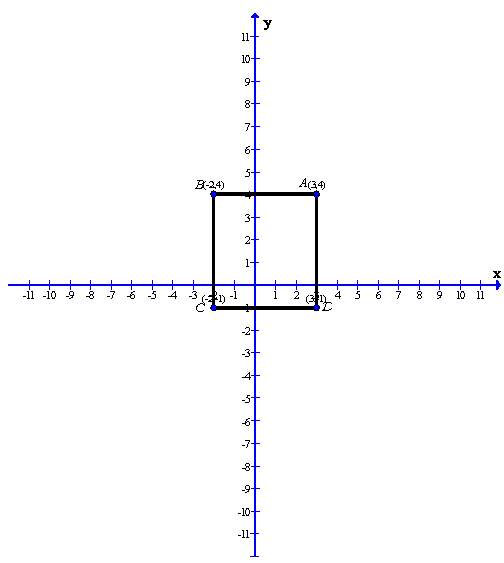
After plotting the given points $A(3,4), B(-2,4)$ and $C(-2,-1)$ on a graph paper;
joining $B$ with $C$ and $B$ with $A$.
From the graph it is clear that the vertical distance between the points $B (-2,4)$ and $C (-2,-1)$ is $5$ units and the horizontal distance between the points $B (-2,4)$ and $A (3,4)$ is $5$ units,
$\therefore$ the vertical distance between the points $A (3,4)$ and $D$ must be 5 units and the horizontal distance between the points $C(-2,-1)$ and $D$ must be $5$ units. Now complete the square $\text{ABCD}$
As is clear from the graph $D(3,-1)$
Now the area of the square $\text{ABCD}$ is given by area of $\text{ABCD}=(\text { side })^2=(5)^2=25$ units

Need a full question paper?

Generate a complete, print-ready paper with questions like this in minutes — across 16+ boards, with answer keys.

Start Generating Free

Similar questions

Solve the following simultaneous equations by the substitution method$:\ 0.4x + 0.3y = 1.7,0.7x - 0.2y = 0.8$
A trader bought $25$ boxes of soap from a retailer at $Rs.180$ per box. If each box contains $12$ bars of soaps and the trader sells the soap pieces at $Rs. 18$ per bar, find the profit or loss percent.
$\text{ABCD}$ is a trapezium with $AB \| DC$. A line parallel to $AC$ intersects $AB$ at point $M$ and $BC$ at point $N$.Prove that: area of $\triangle ADM =$ area of $\triangle ACN.$
How much will $Rs. 50,000$ amount to in $3$ years, compounded yearly, if the rates for the successive years are $6\ \%\ , 8\ \%\ $ and $10\ \%\ $ respectively?
Construct the frequency distribution table from the following cumulative frequency table:
Ages No. of students
Below $4$ $0$
Below $7$ $85$
Below $10$ $140$
Below $13$ $243$
Below $16$ $300$
$(i) $State the number of students in the age group $10 - 13.(ii)$ State the age$-$group which has the least number of students.
The side of a square is $\frac{1}{2}(x+1)$ units, and its diagonals is $\frac{3-x}{\sqrt{2}}$
Arrange the following rational numbers in ascending order.$\frac{4}{5}, \frac{6}{7}$ and $\frac{7}{10}$
From the cumulative frequency distribution given below, construct a frequency distribution table:
Marks $c.f.$
Less than $10$ $10$
Less than $20$ $18$
Less than $30$ $32$
Less than $40$ $45$
Less than $50$ $50$
If $\log \frac{a-b}{2}=\frac{1}{2}(\log a+\log b)$, Show that: $a^2+b^2=6 a b$.
$A 12$ litre solution is $33 \frac{1}{2}$ acid. How much water must be added to get the solution having $20 \%$ acid?