MCQ
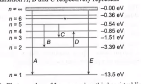
In the above figure $D$ and $E$ respectively represent
  • Absorption line of Balmer series and the ionization potential of hydrogen
  • B
    Absorption line of Balmer series and the wavelength lesser than lowest of the Lyman series
  • C
    Spectral line of Balmer series and the maximum wavelength of Lyman series
  • D
    Spectral line of Lyman series and the absorption of greater wavelength of limiting value of Paschen series
Answer

Correct option: A.
Absorption line of Balmer series and the ionization potential of hydrogen
a
(a) $D$ is excitation of electron from $2nd$ orbit corresponding to absorption line in Balmer series and $E$ is the energy released to bring the electron from $\infty $ to ground state i.e. ionisation potential.

Need a full question paper?

Generate a complete, print-ready paper with questions like this in minutes — across 16+ boards, with answer keys.

Start Generating Free

Similar questions

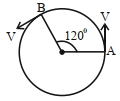
As shown in the figure, a particle is moving with constant speed $\pi\,m / s$. Considering its motion from $A$ to $B$, the magnitude of the average velocity is:
The radius of $R$ of a nucleus of mass number $A$ can be estimated by the formula $R =\left(1.3 \times 10^{-15}\right) A ^{1 / 3}\, m .$ It follows that the mass density of a nucleus is of the order of

$\left( M _{\text {prot. }} \cong M _{\text {neut. }}=1.67 \times 10^{-27} kg \right)$

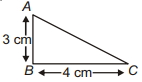
$A B C$ is a right angled triangle situated in a uniform electric field $\vec{E}$ which is in the plane of the triangle. The points $A$ and $B$ are at the same potential of $15 \,V$ while the point $C$ is at a potential of $20 \,V . A B=3 \,cm$ and $B C=4 \,cm$. The magnitude of electric field is (in $S.I.$ Units)
Experimentally it is found that $12.8\,eV$ energy is required to separate a hydrogen atom into a proton and an electron. So the orbital radius of the electron in a hydrogen atom is $\frac{9}{ x } \times 10^{-10}\,m$. The value of the $x$ is $\left(1\,eV =1.6 \times 10^{-19}\,J , \frac{1}{4 \pi \epsilon_0}=9 \times 10^9\,Nm ^2 / C ^2\right.$ and electronic charge $=1.6 \times 10^{-19}\,J\,C$ )
$125$ identical drops each charged to the same potential of $50\;volts$ are combined to form a single drop. The potential of the new drop will be......$V$
If the density of the earth is doubled keeping its radius constant then acceleration due to gravity will be........ $m/{s^2}$ . $(g = 9.8\,m/{s^2})$
A lens of power $+2$ diopters is placed in contact with a lens of power $-1$ diopter. The combination will behave like
An under water swimmer is at a depth of $12$ m below the surface of water. A bird is at a height of $18\, m$ from the surface of water, directly above his eyes. For the swimmer the bird appears to be at a distance from the surface of water equal to .......$m$ (Refractive Index of water is $4/3$)
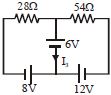
Consider the circuit shown in the figure. The current $I_3$ is equal to
A point charge causes an electric flux of $-2 \times 10^4$ $Nm ^2 C ^{-1}$ to pass through a spherical Gaussian surface of 8.0 cm radius, centred on the charge. The value of the point charge is :
(Given $\in_0=8.85 \times 10^{-12} C ^2 N^{-1} m^{-2}$ )