MCQ
In the above question, the impulse acting on the object is
  • A
    $120$ newton $\times \sec$
  • $-120$ newton $\times \sec$
  • C
    $30$ newton $\times \sec$
  • D
    $-30$ newton $\times \sec$

Answer

Correct option: B.
$-120$ newton $\times \sec$
Impulse $=$ Force $\times$ Time $=-30 \times 4=-120 \mathrm{~N}-\mathrm{s}$

Need a full question paper?

Generate a complete, print-ready paper with questions like this in minutes — across 16+ boards, with answer keys.
Start Generating Free

Similar questions

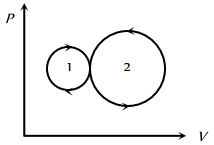
In the following indicator diagram, the net amount of work done will be
Image
Time taken by the sunlight to pass through a window of thickness $4\ \mathrm{mm}$ whose refractive index is $1.5$ is
Two waves $y_1=A_1 \sin \left(\omega t-\beta_1\right), y_2=A_2 \sin \left(\omega t-\beta_2\right)$ Superimpose to form a resultant wave whose amplitude is
In a series circuit $C=2 \mu F, L=1 mH$ and $R=10 \Omega$, when the current in the circuit is maximum, at that time the ratio of the energies stored in the capacitor and the inductor will be
Resonance is an example of
The thickness of a metallic plate is $0.4 \mathrm{~cm}$. The temperature between its two surfaces is $20^{\circ} \mathrm{C}$. The quantity of heat flowing per second is 50 calories from $5 \mathrm{~cm}^2$ area. In CGS system, the coefficient of thermal conductivity will be
In an experiment, the saturation in the plate current in a diode is observed at $240 V$. But a student still wants to increase the plate current. It can be done, if
In case of a simple pendulum, time period versus length is depicted by
A lamp is hanging $1 \mathrm{~m}$ above the centre of a circular table of diameter $1 \mathrm{~m}$. The ratio of illuminaces at the centre and the edge is
Two vibrating strings of the same material but lengths $L$ and $2 L$ have radii $2 r$ and $r$ respectively. They are stretched under the same tension. Both the strings vibrate in their fundamental modes, the one of length $L$ with frequency $n$ and the other with frequency $n$. The ratio $n / n$ is given by