MCQ
In the above reaction $o/p$ ratio will be highest when
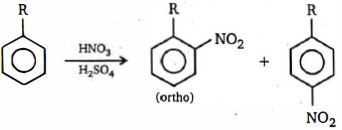
- ✓$R = - CH_3$
- B$R = - CH_2 -CH_3$
- C$R = - CHMe_2$
- D$R = - CMe_3$
Increase in size of $Y$ $\begin{gathered}
\downarrow \hfill \\
\downarrow \hfill \\
\downarrow \hfill \\
\downarrow \hfill \\
\downarrow \hfill \\
\end{gathered} $ $\begin{array}{*{20}{c}}
Y&{\% \,\,o - }&{\% \,p\, - } \\
{C{H_3}}&{58}&{37} \\
{C{H_2}Me}&{45}&{49} \\
{CHM{e_2}}&{30}&{62} \\
{CM{e_3}}&{16}&{73}
\end{array}$
Generate a complete, print-ready paper with questions like this in minutes — across 16+ boards, with answer keys.
| Acid | $HF$ | $HCL$ | $HBr$ | $HI$ |
| $K_a$ | $7.2 \times 10^{-4}$ | $1 \times 10^6$ | $1 \times 10^9$ | $3 \times 10^{11}$ |
Which of these Bronsted acids would have the weakest conjugate base ?
Statement $I$: Fluorine has most negative electron gain enthalpy in its group.
Statement $II$: Oxygen has least negative electron gain enthalpy in its group.
In the light of the above statements, choose the most appropriate from the options given below.
$\frac{1}{2}{P_4}(s) + 3C{l_2}(g) \to 2PC{l_3}(l)\,;$ $\Delta H=-635 \,kJ$
$PC{l_3}(l) + C{l_2}(g) \to PC{l_5}(s)\,;$ $\Delta H=-137\, kJ$
The value of heat of formation of $PCl_5$ is ......$kJ\,mol^{-1}$