MCQ
In the above reaction $o/p$ ratio will be highest when
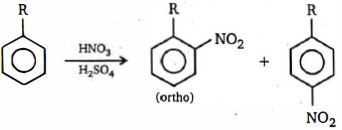
  • $R = - CH_3$
  • B
    $R = - CH_2 -CH_3$
  • C
    $R = - CHMe_2$
  • D
    $R = - CMe_3$

Answer

Correct option: A.
$R = - CH_3$
a
$(a)$ The steric demand of $H^{\ominus}$  is, however extremely small, and  when attack on $C_6H_5Y$ is by any other electrophile, $E^{\oplus}$ , which  will necessarily be larger, there will be increasing interaction between $E$ and $Y$ in the transition state for attack at the position $o-$ to $Y (57 \,b, R = E)$  as attacking electrophile and substituent increase in size ; there can be no such interaction in the transition state for $p-$ attack $(57a, R = E)$. This will  be reflected in an increasing $\Delta \,G^+$ for $o-$ attack, a consequently  slower reaction, and the relative proportion of $o-$ product will thus fall as the  size of $E$ and / or $Y$ increase. This is illustrated by the falling $f_{o^-} /f_{p^-}$ ratios which are  observed for the nitration of alkylbenzenes $(Y ---CH_3 \to CMe_3)$ under comparable conditions ; 

Increase in size of $Y$ $\begin{gathered}
   \downarrow  \hfill \\
   \downarrow  \hfill \\
   \downarrow  \hfill \\
   \downarrow  \hfill \\
   \downarrow  \hfill \\ 
\end{gathered} $ $\begin{array}{*{20}{c}}
  Y&{\% \,\,o - }&{\% \,p\, - } \\ 
  {C{H_3}}&{58}&{37} \\ 
  {C{H_2}Me}&{45}&{49} \\ 
  {CHM{e_2}}&{30}&{62} \\ 
  {CM{e_3}}&{16}&{73} 
\end{array}$

Need a full question paper?

Generate a complete, print-ready paper with questions like this in minutes — across 16+ boards, with answer keys.

Start Generating Free

Similar questions

An ideal gas is allowed to expand from $1\, L$ to $10\, L$ against a constant external pressure of $1\,bar$. The work done in $kJ$ is
Most stable conformation of  $n-$ butane is
Which of the following pair of molecules will have permanent dipole moment?
The $IUPAC$ name of $\begin{matrix}
   \,\,\,\,\,\,\,\,\,\,\,\,\,\,\,\,\,\,\,\,\,\,\,\,\,\,\,\,\,\,\,\,\,\,\,\,\,\,\,\,O  \\
   \,\,\,\,\,\,\,\,\,\,\,\,\,\,\,\,\,\,\,\,\,\,\,\,\,\,\,\,\,\,\,\,\,\,\,\,\,\,\,||  \\
   C{{H}_{3}}-CH-C{{H}_{2}}-C-Br  \\
   |\,\,\,\,\,\,\,\,\,\,\,\,\,\,\,\,\,\,\,\,\,\,\,\,\,\,\,\,  \\
   C{{H}_{3}}\,\,\,\,\,\,\,\,\,\,\,\,\,\,\,\,\,\,\,\,\,\,\,\,  \\
\end{matrix}$ is
The compound that is chiral is
The correct order of $I.E_2.$ is
Answer the following by appropriately matching the lists based on the information given in the paragraph Consider the Bohr's model of a one-electron atom where the electron moves around the nucleus. In the following $List-I$ contains some quantities for the $n^{t /}$ orbit of the atom and $List-II$ contains options showing how they depend on $n$.

Which of the following options has the correct combination considering $List-I$ and $List-II$?

$List-I$ $List-II$
$(I)$ Radius of the $n^{\text {th }}$ orbit $(P)$ $\propto n ^{-2}$
$(II)$ Angular momentum of the electron in the $n^{\text {th }}$ orbit $(Q)$ $\propto n ^{-1}$
$(III)$ Kinetic energy of the electron in the $n^{\text {th }}$ orbit $(R)$ $\propto n ^0$
$(IV)$ Potential energy of the electron in the $n^{\text {th }}$ orbit $(S)$ $\propto n ^1$
  $(T)$ $\propto n ^2$
  $(U)$ $\propto n ^{1 / 2}$

($1$) Which of the following options has the correct combination considering $List-I$ and $List-II$?

$(1) (II), (R)$ $(2) (I), (P)$ $(3) (I), (T)$ $(4) (II), (Q)$

($2$) Which of the following options has the correct combination considering $List-I$ and $List-II$?

$(1) (III), (S)$ $(2) (IV), (Q)$ $(3) (IV),(U)$ $(4) (III), (P)$

Give the answer or quetion ($1$) and ($2$)

Which of the statements below best describes a functional group?
Homolytic fission of $C - C$ bond in ethane gives an intermediate in which carbon is
Formation of polyethylene from calcium carbide takes place as follows

$Ca{C_2} + 2{H_2}O \to Ca{(OH)_2} + {C_2}{H_2}$

${C_2}{H_2} + {H_2} \to {C_2}{H_4}$

$n({C_2}{H_4}) \to {( - C{H_2} - C{H_2} - )_n}$

The amount of polyethylene obtained from $64.1\, kg$ $Ca{C_2}$ is......$kg$