Question
In the Auger process an atom makes a transition to a lower state without emitting a photon. The excess energy is transferred to an outer electron which may be ejected by the atom. (This is called an Auger electron). Assuming the nucleus to be massive, calculate the kinetic energy of an n = 4 Auger electron emitted by Chromium by absorbing the energy from a n = 2 to n = 1 transition.
Answer

As the nucleus is massive, recoil momentum of the atom may be neglected and the entire energy of the transition may be considered transferred to the Auger electron. As there is a single valence electron in Cr, the energy states may be thought of as given by the Bohr model.

The energy of the nth state $\text{En}=-\text{Z}^2\text{R}\frac{1}{\text{n}^2}$ where R is the Rydberg constant and Z = 24.

The energy released in a transition form 2 to 1 is $\Delta\text{t}=\text{Z}^2\text{R}\Big(1-\frac{1}{4}\Big)=\frac{3}{4}\text{Z}^2\text{R}$.

The energy required to eject a n = 4 electron is $\text{E}_4=\text{Z}^2\text{R}\frac{1}{16}$.

Thus, the kinetic energy of the Auger electron is $\text{KE}=\text{Z}^2\text{R}\Big(\frac{3}{4}-\frac{1}{16}\Big)=\frac{1}{16}\text{Z}^2\text{R}$

$=\frac{11}{16}\times24\times24\times13.6\text{eV}=5385.6\text{eV}.$

Need a full question paper?

Generate a complete, print-ready paper with questions like this in minutes — across 16+ boards, with answer keys.

Start Generating Free

Similar questions

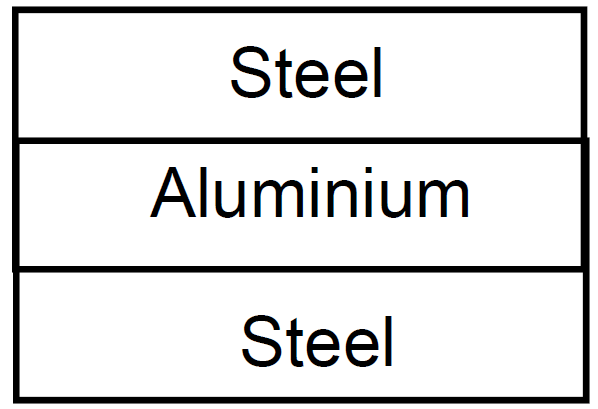
Two steel rods and an aluminium rod of equal length l0 and equal cross section are joined rigidly at their ends as shown in the figure below. All the rods are in a state of zero tension at 0°C. Find the length of the system when the temperature is raised to $\theta$. Coefficient of linear expanaion of aluminium and steel are $\alpha_\text{a}$ and $\alpha_\text{s}$respectively. Young's modulus of aluminium is Ya and of steel is Ys.

Radiation coming from transition n = 2 to n = 1 of hydrogen atoms falls on helium ions in n = 1 and n = 2 states. What are the possible transitions of helium ions as they absorbs energy from the radiation?
Two particles A and B having charges q and 2q respectively are placed on a smooth table with a separation d. A third particle C is to be clamped on the table in such a way that the particles A and B remain at rest on the table under electrical forces. What should be the charge on C and where should it be clamped?
State Gauss's Theorem and prove it.
Write the definition of electric capacitance. A parallel plate capacitor is filled with a medium of dielectric constant K between the plates. Find the expression of its capacitance. Draw the necessary diagram.
A capacitor of capacitance $10\mu\text{F}$ is connected to a battery of emf 2V. It is found that it takes 50ms for the charge of the capacitor to become $12.6\mu\text{C}.$ Find the resistance of the circuit.
A solenoid having inductance 4.0H and resistance $10\Omega$ is connected to a 4.0V battery at t = 0. Find
  1. The time constant.
  2. The time elapsed before the current reaches 0.63 of its steady-state value.
  3. The power delivered by the battery at this instant.
  4. The power dissipated in Joule heating at this instant.
A composite slab is prepared by pasting two plates of thicknesses L1 and L2 and thermal conductivities K1 and K2. The slabs have equal cross-sectional area. Find the equivalent conductivity of the composite slab.
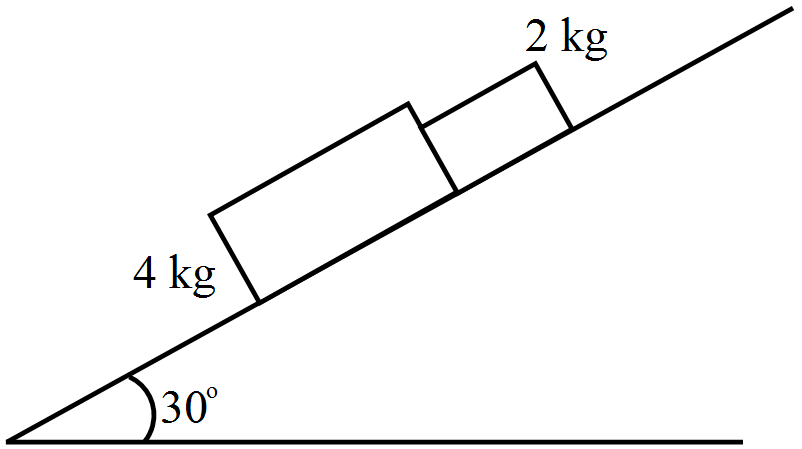
Figure shows two blocks in contact sliding down an inclined surface of inclination 30°. The friction coefficient between the block of mass 2.0kg and the incline is $\mu_1,$ and that between the block of mass 4.0kg and the incline is $\mu_2.$ Calculate the acceleration of the 2.0kg block if:

  1. $\mu_1=0.20$ and $\mu_2=0.30$
  2. $\mu_1=0.30$ and $\mu_2=0.20$ Take $\text{g}=10\text{m/s}^2.$

What are the dimensions of $\chi$, the magnetic susceptibility? Consider an H-atom. Guess an expression for $\chi$, upto a constant by constructing a quantity of dimensions of $\chi$, out of parameters of the atom: e, m, v, R and μ0 . Here, m is the electronic mass, v is electronic velocity, R is Bohr radius. Estimate the number so obtained and compare with the value of $|\chi|\sim10^{-5}$ for many solid materials.