Question
In the Boolean algebra, the following one is wrong:

Answer

  1. 1.1 = 0
Explanation:
In the Boolean algebra,
1.0 = 0
0.1 = 0
1.1 = 1

Need a full question paper?

Generate a complete, print-ready paper with questions like this in minutes — across 16+ boards, with answer keys.
Start Generating Free

Similar questions

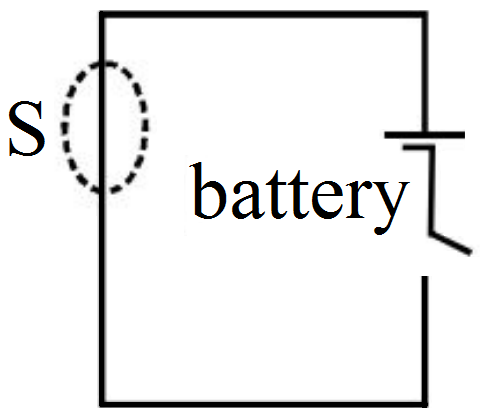
A closed surface S is constructed around a conducting wire connected to a battery and a switch (figure). As the switch is closed, the free electrons in the wire start moving along the wire. In any time interval, the number of electrons entering the closed surface S is equal to the number of electrons leaving it. On closing the switch, the flux of the electric field through the closed surface:
Inside a uniform spherical shell:
  1. The gravitational potential is zero.
  2. The gravitational field is zero.
  3. The gravitational potential is same everywhere.
  4. The gravitational field is same everywhere.
The time taken by a photo$-$electron to come out after the photon strikes is approximately:
The first law of thermodynamics is a statement of:
  1. Conservation of heat.
  2. Conservation of work.
  3. Conservation of momentum.
  4. Conservation of energy.
In a step up transformer, 220 V is converted into 200 V. The number of turns in primary coil is 600. What is the number of turns in the secondary coil(a) 60(b) 600(c) 6000  (d) 100
       
An electron has mass $9 {\times 10^{-31} kg}$  and charge $1.6 {\times 10^{-19} C}$  is moving with a velocity of $10^6 m / s,$ enters a region where magnetic field exists. If it describes a circle of radius $0.10 m,$ the intensity of magnetic field must be
The x-component of the resultant of several vectors:
  1. Is equal to the sum of the x-components of the vectors.
  2. May be smaller than the sum of the magnitudes of the vectors.
  3. May be greater than the sum of the magnitudes of the vectors.
  4. May be equal to the sum of the magnitudes of the vectors.
Choose the correct answer from alternatives given.
If $\overrightarrow{\text{E}}$ and $\overrightarrow{\text{B}}$ represent electric and magnetic field vectors of an electromagnetic wave, the direction of propagation of the wave is along.
A compass needle which is allowed to move in a horizontal plane is taken to a geomagnetic pole. It:
  1. Will stay in north-south direction only.
  2. Will stay in east-west direction only.
  3. Will become rigid showing no movement.
  4. Will stay in any position.
On increasing the temperature of a semi-conductor material: