MCQ
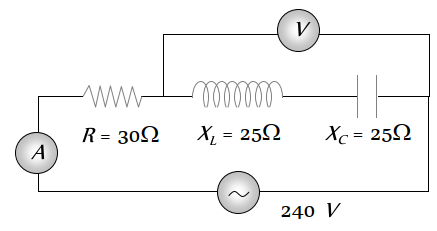
In the circuit shown in figure neglecting source resistance the voltmeter and ammeter reading will respectively, will be
Image
  • A
    $0 V, 3 A$
  • B
    $150 V , 3 A$
  • C
    $150 V , 6 A$
  • $0 V , 8 A$

Answer

Correct option: D.
$0 V , 8 A$
The voltage $V_L$ and $V_C$ are equal and opposite so voltmeter reading will be zero.
Also $R=30 \Omega, X_L=X_C=25 \Omega$
So $i=\frac{V}{\sqrt{R^2+\left(X_L-X_C\right)^2}}=\frac{V}{R}=\frac{240}{30}=8 \mathrm{~A}$

Need a full question paper?

Generate a complete, print-ready paper with questions like this in minutes — across 16+ boards, with answer keys.
Start Generating Free

Similar questions

A beam of light of wavelength $\lambda$ and with illumination $L$ falls on a clean surface of sodium. If $N$ photoelectrons are emitted each with kinetic energy $E$, then
The optical path of a monochromatic light is same if it goes through $4.0 \mathrm{~cm}$ of glass or $4.5 \mathrm{~cm}$ of water. If the refractive index of glass is $1.53,$ the refractive index of the water is
If the resultant of $n$ forces of different magnitudes acting at a point is zero, then the minimum value of $n$ is
Match List-l with List-ll and select the correct answer using the codes given below the lists
List-1 List-ll
I. Joule A. Henry $\times$ Amp/sec
II. Watt B. Farad $\times$ Volt
III. Volt C. Coulomb $\times$ Volt
IV. Coulomb D. Oersted $\times cm$
E. Amp $\times$ Gauss
F. $A m p^2 \times Ohm$
If a load of $9 kg$ is suspended on a wire, the increase in length is $4.5 mm$. The force constant of the wire is
The r.m.s. value of an ac of $50 Hz$ is $10 amp$. The time taken by the alternating current in reaching from zero to maximum value and the peak value of current will be
An ideal monoatomic gas is taken round the cycle $A B C D A$ as shown in following $P-V$ diagram. The work done during the cycle is
Image
A man measures time period of a pendulum $(T)$ in stationary lift. If the lift moves upward with acceleration $\frac{g}{4}$, then new time period will be
A body of mass $2 \mathrm{~kg}$ is being dragged with uniform velocity of $2 \mathrm{~m} / \mathrm{s}$ on a rough horizontal plane. The coefficient of friction between the body and the surface is $0.20.$ The amount of heat generated in $5 \mathrm{sec}$ is $\left(J=4.2 \text { joule } / \mathrm{cal} \text { and } g=9.8 \mathrm{~m} / \mathrm{s^2}\right)$
Two rods of same material and length have their electric resistance in ratio $1: 2$. When both rods are dipped in water, the correct statement will be