MCQ
In the coordinate valency
  • A
    Electrons are equally shared by the atoms
  • Electrons of one atom are shared with two atoms
  • C
    Hydrogen bond is formed
  • D
    None of the above

Answer

Correct option: B.
Electrons of one atom are shared with two atoms
b
The $2$ electrons of an atom ( generally lone pair) is donated by one atom to the other atom and it results in the formation of a coordinate bond. A chemical bond between two atoms in which a shared pair of electrons forms the bond and the pair has been supplied by one of the two atoms.

Need a full question paper?

Generate a complete, print-ready paper with questions like this in minutes — across 16+ boards, with answer keys.

Start Generating Free

Similar questions

Solder is an alloy of
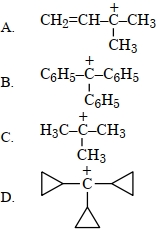
The decreasing order of hydride affinity for following carbocations is:

Choose the correct answer from the options given below:
The number of enantiomers of the compound $C{H_3}CHBrCHBrCOOH$ is
Propene and propyne can be differentiated by :
According to Kirchoff equation which of the following factor effect the enthalpy of reaction:
Arrange the following in order of their leaving group tendency?

$(I)\,\,B{r^ - }{\mkern 1mu} {\mkern 1mu} {\mkern 1mu} {\mkern 1mu} $       $(II)\,\,\begin{array}{*{20}{c}}
  {{\mkern 1mu} {\mkern 1mu} {\mkern 1mu} {\mkern 1mu} {\mkern 1mu} O{\mkern 1mu} } \\ 
  {{\mkern 1mu} {\mkern 1mu} {\mkern 1mu} {\mkern 1mu} ||} \\ 
  {{H_3}C - C - {O^ - }} 
\end{array}$    $(III)\,\,C{H_3}C{H_2}{O^ - }$    $(IV)\,\,Ph - {O^ - }$

From the given data of equilibrium constant of following reactions

$C{O_{2(s)}} + {H_{2(g)}} \rightleftharpoons C{O_{(s)}} + {H_2}O(g)\,;\,{K_1}$

$C{O_{2(s)}} + CO(g) \rightleftharpoons C{O_{(s)}} + C{O_2}(g)\,;\,{K_2}$

Calculate the equilibrium for the reaction

$C{O_{2(s)}} + {H_2}(g) \rightleftharpoons CO(g) + {H_2}O(g)\,$
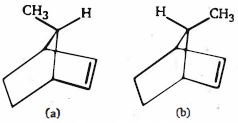
Rate of reaction towards reduction using $(H_2 /Pt)$
Identify the correct statements about p-block elements and their compounds.

$(A)$ Non metals have higher electronegativity than metals.

$(B)$ Non metals have lower ionisation enthalpy than metals.

$(C)$ Compounds formed between highly reactive nonmetals and highly reactive metals are generally ionic.

$(D)$ The non-metal oxides are generally basic in nature.

$(E)$ The metal oxides are generally acidic or neutral in nature.

The standard enthalpy of formation of $NH_3$ is $-46.0\, kJ/mol$. If the enthalpy of formation of $H_2$ from its atoms is $-436\, kJ/mol$ and that of $N_2$ is $-712\, kJ/mol$, the average bond enthalpy of $N - H$ bond in $NH_3$ is......$kJ/mol$