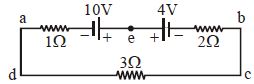
In the circuit diagram shown below, the magnitude and direction of the flow of current respectively would be
Medium


Download our appand get started for free
Experience the future of education. Simply download our apps or reach out to us for more information. Let's shape the future of learning together!No signup needed.*
Similar Questions
- 1Two electric bulbs whose resistance are in the ratio of $1: 2$, are connected in parallel to a constant voltage source. The power dissipated in them has the ratioView Solution
- 2If a $0.1\%$ increase in length due to stretching, the percentage increase in its resistance will be ............ $\%$View Solution
- 3What is the resistance of a carbon resistance which has bands of colours brown, black and brown .............. $\Omega$View Solution
- 4View SolutionThe internal resistance of a cell is the resistance of
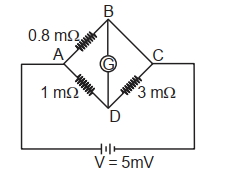
- 5To measure the temperature coefficient of resistivity $\alpha$ of a semiconductor, an electrical arrangement shown in the figure is prepared. The arm BC is made up of the semiconductor. The experiment is being conducted at $25^{\circ} \mathrm{C}$ and resistance of the semiconductor arm is $3 \mathrm{~m} \Omega$. Arm BC is cooled at a constant rate of $2^{\circ} \mathrm{C} / \mathrm{s}$. If the galvanometer $\mathrm{G}$ shows no deflection after $10 \mathrm{~s}$, then $\alpha$ is :View Solution
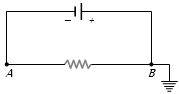
- 6A battery is connected to a uniform resistance wire $AB$ and $B$ is earthed. Which one of the graphs below shows how the current density $J$ varies along $AB$View Solution
- 7In a conductor $4$ coulombs of charge flows for $2$ seconds. The value of electric current will beView Solution
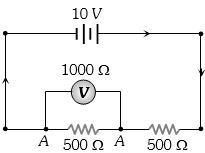
- 8What is the reading of voltmeter in the following figure .............. $V$View Solution
- 9The temperature coefficient of resistance of tungsten is $4.5 \times 10^{-3}{ }^{\circ} C ^{-1}$ and that of germanium is $-5 \times 10^{-2}{ }^{\circ} C ^{-1}$. A tungsten wire of resistance $100 \,\Omega$ is connected in series with a germanium wire of resistance $R$. The value of $R$ for which the resistance of combination does not change with temperature is .......... $\Omega$View Solution
- 10The heat developed in an electric wire of resistance $R$ by a current $I$ for a time $t$ isView Solution