Question

In the circuit given below, V(t) is the sinusoidal voltage source, voltage drop VAB(t) across the  resistance R is
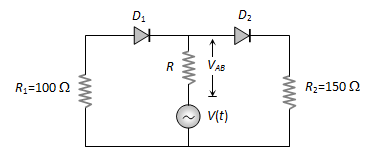
(a) Is half wave rectified

(b) Is full wave rectified

(c) Has the same peak value in the positive and negative half cycles

(d) Has different peak values during positive and negative half cycle 

Answer

(d) Has different peak values during positive and negative half cycle 

Need a full question paper?

Generate a complete, print-ready paper with questions like this in minutes — across 16+ boards, with answer keys.

Start Generating Free

Similar questions

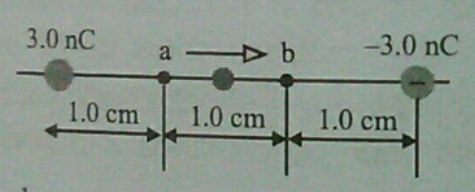
As shown in figure a dust particle with mass m = 5.0 × 10⁻⁹ kg and charge q= 2.0nC starts from rest at point a and moves in a straight line to point b. What is its speed v at point b?

When a source of light is receding away from an observer, then the spectral lines will get displaced towards:
In Bohr model of hydrogen atom, let P.E. represents potential energy and T.E. represents the total energy. In going to a higher level:

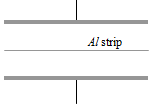
As shown in the figure, a very thin sheet of aluminium is placed in between the plates of the condenser. Then the capacity

(a) Will increase

(b) Will decrease

(c) Remains unchanged

(d) May increase or decrease

A beam of well collimated cathode rays travelling with a speed of 5   enter a region of mutually perpendicular electric and magnetic fields and emerge undeviated from this region. If |B| = 0.02T, the magnitude of the electric field is

(a)  

(b) 2.5  

(c) 1.25  

(d) 2 

To construct a barometer, a tube of length 1m is filled completely with mercury and is inverted in a mercury cup. The barometer reading on a particular day is 76cm. Suppose a 1m tube is filled with mercury up to 76cm and then closed by a cork. It is inverted in a mercury cup and the cork is removed. The height of mercury column in the tube over the surface in the cup will be.
  1. zero.
  2. 76cm.
  3. > 76cm.
  4. < 76cm.

If an interference pattern have maximum and minimum intensities in 36 : 1 ratio then what will be the ratio of amplitudes

(a) 5 : 7

(b) 7 : 4

(c) 4 : 7

(d) 7 : 5

As compared to 12C atom, 14C atom has:
  1. Two extra protons and two extra electrons.
  2. Two extra protons but no extra electron.
  3. Two extra neutrons and no extra electron.
  4. Two extra neutrons and two extra electrons.
Which is not an electrostatic phenomenon:
The Kirchhoff's second law $\Big(\sum\text{iR}=\sum\text{E}\Big)$ where the symbols have their usual meanings, is based on: