MCQ
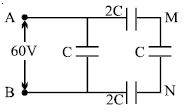
In the circuit shown, a potential difference of $60\,V$ is applied across $AB$. The potential difference between the point $M$ and $N$ is.....$V$
  • A
    $10$ 
  • B
    $15$ 
  • C
    $20$
  • $30$ 

Answer

Correct option: D.
$30$ 
d
In series combination potential divides in inverse ration of capacity

$V_{1}: V_{2}: V_{3}=\frac{1}{2 C}: \frac{1}{C}: \frac{1}{2 C}$

$V_{1}: V_{2}: V_{3}=\frac{1}{2}: \frac{1}{2}: \frac{1}{2}$

$V_{1}: V_{2}: V_{3} \equiv 1: 2: 1$

$V_{2}=\frac{2}{4} \times 60 V=30 V$

Need a full question paper?

Generate a complete, print-ready paper with questions like this in minutes — across 16+ boards, with answer keys.

Start Generating Free

Similar questions

In the context of Doppler effect in light, the term ‘red shift’ signifies
The coil of area 0.1 $\mathrm{m}^2$ has 500 turns. After placing the coil in a magnetic field of strength $4 \times 10^{-4} \mathrm{wb} / \mathrm{m}^2$, if rotated through $90^{\circ}$ in 0.1 s, the average emf induced in the coil is
The energy of a photon of light with wavelength $5000\, Å$ is approximately $2.5 eV$. This way the energy of an $X-$ ray photon with wavelength $1\,Å $ would be
$X-$ rays are produced due to
The two metallic plates of radius $r$ are placed at a distance $d$ apart and its capacity is $C$. If a plate of radius $r/2$ and thickness $d$ of dielectric constant $6$ is placed between the plates of the condenser, then its capacity will be
The ratio of secondary to primary turns is $9:4.$ If power input is $P$, what will be the ratio of power output (neglect all losses) to power input
A parallel plate air capacitor is charged to a potential difference of V. After disconnecting the battery, distance between the plates of the capacitor is increased using an insulating handle. As a result, the potential difference between the plates
If the mass number of an atom is A = 40 and its electron configuration is $1 s^2, 2 s^2, 2 p^6, 3 s^2, 3 p^6$ , the number of neutrons and protons in its nucleus will be
A step-up transformer has transformation ratio of 3 : 2. What is the voltage in secondary if voltage in primary is 30 V
Two particles each of mass $m$ and charge $q$ are separated by distance $r_1$ and the system is left free to move at $t = 0$. At time $t$ both the particles are found to be separated by distance $r_2$. The speed of each particle is