Question
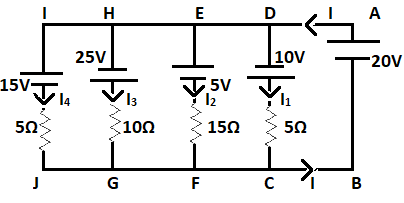
 In the circuit shown below, calculate the current flowing through $20V$ cell.
Image

Answer

Here, we can apply Kirchhoff’s loop rule in closed loops $\text{ADCBA, AEFBA, AHGBA,}$ and $\text{AIJBA.}$ Thus, we get
$20 + 10 – 5I_1 = 0 \rightarrow I_1 = 6A$
$-5 + 20 – 15I_2 = 0 \rightarrow I_2 = 1A$
$25 + 20 – 10I_3 = 0 \rightarrow I_3 = 4.5A$
$-15 + 20 – 5I_4 = 0 \rightarrow I_4 = 1A$
Therefore, the current flowing through the $20V$ cell $= 6 + 1 + 4.5 + 1 = 12.5A$

Need a full question paper?

Generate a complete, print-ready paper with questions like this in minutes — across 16+ boards, with answer keys.
Start Generating Free

Similar questions

The relation between $a$ and $b$ parameters of current gains for a transistors is given by
If $\mathrm{R}_1$ and  $\mathrm{R}_2$ are respectively the filament resistances of a $200$ watt bulb and $100$ watt bulb designed to operate on the same voltage, then
Assertion : The positively charged nucleus of an atom has a radius of almost $10^{-15} \mathrm{~m}$
Reason : In $\alpha-$particle scattering experiment, the distance of closest approach for $\alpha-$particles is $\simeq 10^{-15} \mathrm{~m}$
The mass of a neutron is:
In a coil of self inductance 0.5 henry, the current varies at a constant rate from zero to 10 amperes in 2 seconds. The e.m.f. generated in the coil is(a) 10 volts(b) 5 volts(c) 2.5 volts(d) 1.25 volts
       
The rays of different colours fail to converge at a point after going through a converging lens. This defect is called:
A girl brings a positively charged rod near a thin neutral stream of water flowing from a tap. She observes, that the water stream, bends towards her. Instead, if she is to bring a negativity charged rod near to the stream, it will:
Which of the following logic gates is an universal gate?
A dielectric slab is inserted between the plates of an isolated charged capacitor. Which of the following quantities will remain the same?
Two conductors made of the same material are connected across a common potential difference. Conductor $A$ has twice the diameter and twice the length of conductor $B .$ The power delivered to the two conductors $\mathrm{P}_{\mathrm{A}}$ and $\mathrm{P}_{\mathrm{B}}$ respectively is such that $\mathrm{P}_{\mathrm{A}} / \mathrm{P}_{\mathrm{B}}$ equals to